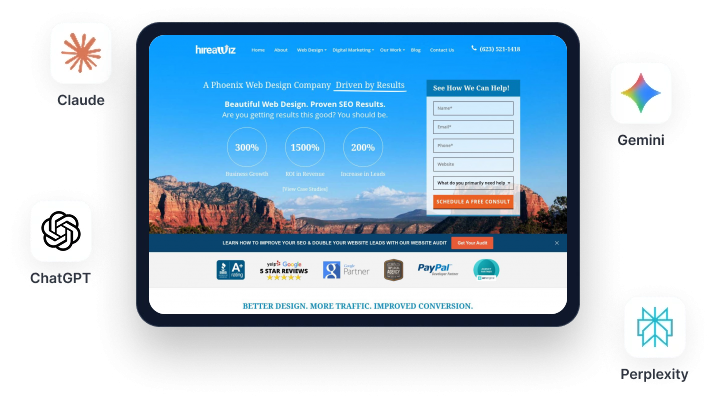
This report analyzes the URLs and domains cited by AI platforms when responding to queries relevant to your business. By examining citation patterns across ChatGPT, Claude, Perplexity, and Gemini, we identify the content formats and sources most likely to earn AI citations, helping you optimize your online presence for greater visibility in AI-generated responses.
Overview
-
Total unique domains cited: 180
-
Top content types by citation frequency: Directory/Aggregator Pages, Service/Product/Organization Pages, Guide/Educational Content, Cost/Pricing Content
-
Key finding: AI platforms heavily prioritize directory and service provider pages in web design and SEO categories, with multiple high-authority aggregators cited consistently across search phrases and platforms, highlighting both competitive presence and new listing opportunities.
Content Pattern Analysis
The citation landscape shows a strong emphasis on Directory/Aggregator Pages and Service/Product/Organization Pages, reflecting AI platforms’ preference for authoritative business listings and direct service provider pages offering specific, localized information. Guide/Educational Content and Cost/Pricing Content are also prominent, supporting informational and pricing-related user intents with detailed, structured explanations about services and pricing. This pattern suggests the brand should strengthen presence in comprehensive directories and expand educational and pricing content to capture wider AI visibility.
Directory/Aggregator Pages
122 citations across 36 search phrases
Directory and aggregator pages are highly cited because they aggregate multiple providers in a structured manner, providing AI platforms with diverse options and comprehensive regional expertise. Their listings often feature rankings, reviews, or curated company profiles that help answer discovery and comparative queries efficiently. Notable signals include domains primarily offering multi-business listings with page titles referencing multiple companies or rankings.
Example URLs:
Service/Product/Organization Pages
103 citations across 38 search phrases
Service and organization pages are commonly cited because they provide specific information about individual companies’ offerings, locations, and expertise that satisfy branded and localized intent. These pages often include detailed service descriptions, contact information, testimonials, and portfolio elements. The URLs typically contain service-related slugs on single-entity domains, and domain types are commercial business (.com) or agency sites.
Example URLs:
Guide/Educational Content
76 citations across 23 search phrases
Guide and educational content is citable due to its instructional or explanatory nature that helps users understand complex topics, such as SEO campaigns, web design processes, and pricing considerations. Signals include URLs with /blog/, /guide/, /how-to/ in their paths and titles featuring phrases like “how to,” “tips,” or “what to expect.” These pages offer structured content that supports informational intent queries effectively.
Example URLs:
Cost/Pricing Content
54 citations across 16 search phrases
Cost and pricing content tends to be cited because it directly addresses user queries concerning financial aspects of website design and SEO services. These pages typically highlight specific pricing structures, packages, budgets, and fee overviews. URLs and titles often include words like “cost,” “pricing,” “rates,” or “how much.” These pages provide transparent, quantifiable information that aligns well with pricing intent queries.
Example URLs:
Video Content
15 citations across 5 search phrases
Video content is referenced for visual and detailed explanatory materials, often hosted on major platforms like YouTube. Such content supplements other informational sources and provides engaging, easy-to-digest answers. These URLs predominantly belong to youtube.com or contain "/watch" or "/shorts".
Example URLs:
Platform Citation Preferences
Claude-cited results frequently include Directory/Aggregator Pages and Service/Product Pages, reflecting emphasis on business discovery and direct provider information.
ChatGPT responses also heavily cite Directory/Aggregator Pages and Guide/Educational content, favoring structured lists and how-to guides alongside service pages.
Gemini demonstrates balanced citation across Directory/Aggregator Pages and Pricing Content, indicating a focus on factual pricing and comparative discovery.
Perplexity citations emphasize Guide/Educational and Pricing content, supporting detailed informational queries, along with robust referencing of Service/Product Pages.
Search phrases labeled as "Discovery" mostly garner citations from Directory/Aggregator and Service/Product Pages, underscoring the AI preference for comprehensive local and business listings to satisfy intent.
"Pricing" queries predominantly attract Cost/Pricing Content and Guide/Educational Content citations, ensuring users find transparent cost details and explanations.
"Branded" queries relate closely to Service/Product/Organization Pages and some Directory listings where the brand appears, suggesting the importance of optimizing branded content and third-party profiles.
Overall, the brand should prioritize expanding or optimizing listings on key directories where it is absent or underrepresented and enhance detailed pricing and educational content to capture both discovery and pricing intents in AI visibility.