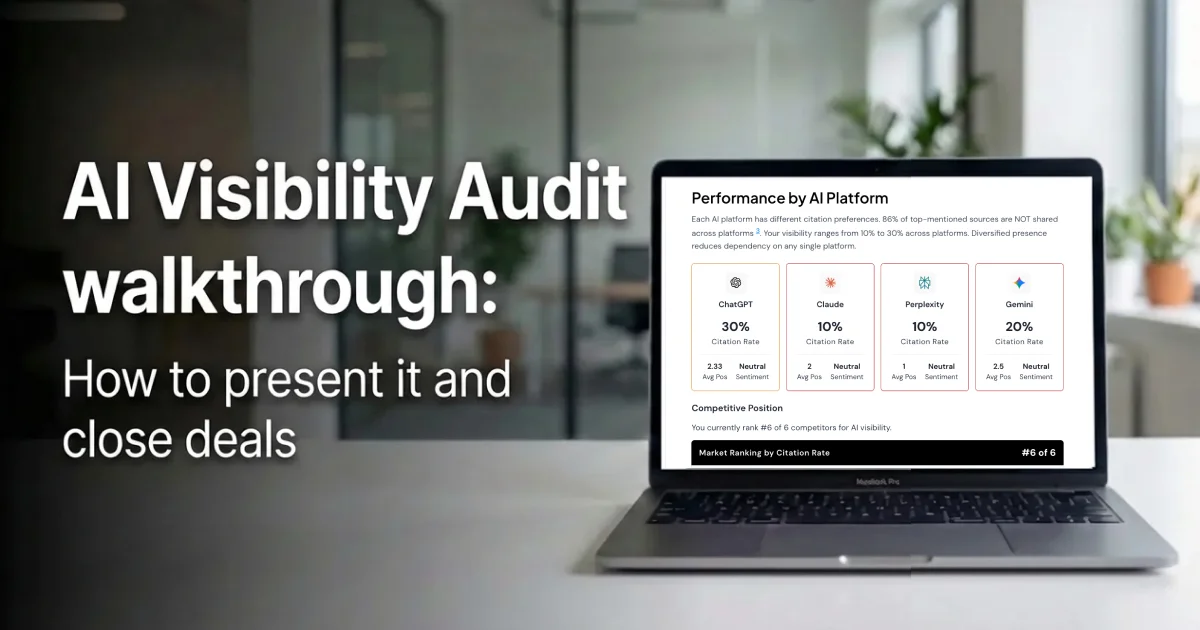
AI Visibility Audit walkthrough
There's a lot of noise around AI search right now. Some of it matters. Most of it doesn't. If you've been following the space at all, you've seen and heard the predictions "SEO is dead because of AI Search" or "do this to rank in AI in 24 hours," marketing that makes it hard to separate signal from noise.
Our AI Visibility Audit was built to cut through the noise. After 25+ years in the website, SEO and digital marketing space, building My Web Audit and running HIREAWIZ, and working alongside SEO and AEO experts who've been deep in this space, we put together a report that gives agencies a clear, data-backed picture of how their prospects and clients' businesses actually show up across ChatGPT, Claude, Perplexity, and Gemini: real prompts, real citation data, and real competitive intelligence.
I've walked both prospects and clients through the insights in this report, and the reaction is almost always the same. They had no idea this data existed. One client who recently started working with us reviewed the report, looked amazed, and said, "So my competitor is showing up on ChatGPT for every search term I care about, and I'm not on there at all?" That's the kind of clarity this report creates. The next question is: how can we increase visibility and traffic from AI search? We didn’t just tell them how; we showed them the gaps and closed the deal. They are now on a monthly retainer to improve their website and search presence on Google and other popular AI search platforms.
Next, we will go through a section-by-section walkthrough of the AI Visibility Audit report. What each part covers, why it's there, and how to use it when you're sitting across from a client or presenting this report via a Zoom call. No hype. No pressure. Just the details so you can evaluate it yourself.
Table of Contents
The Executive Summary
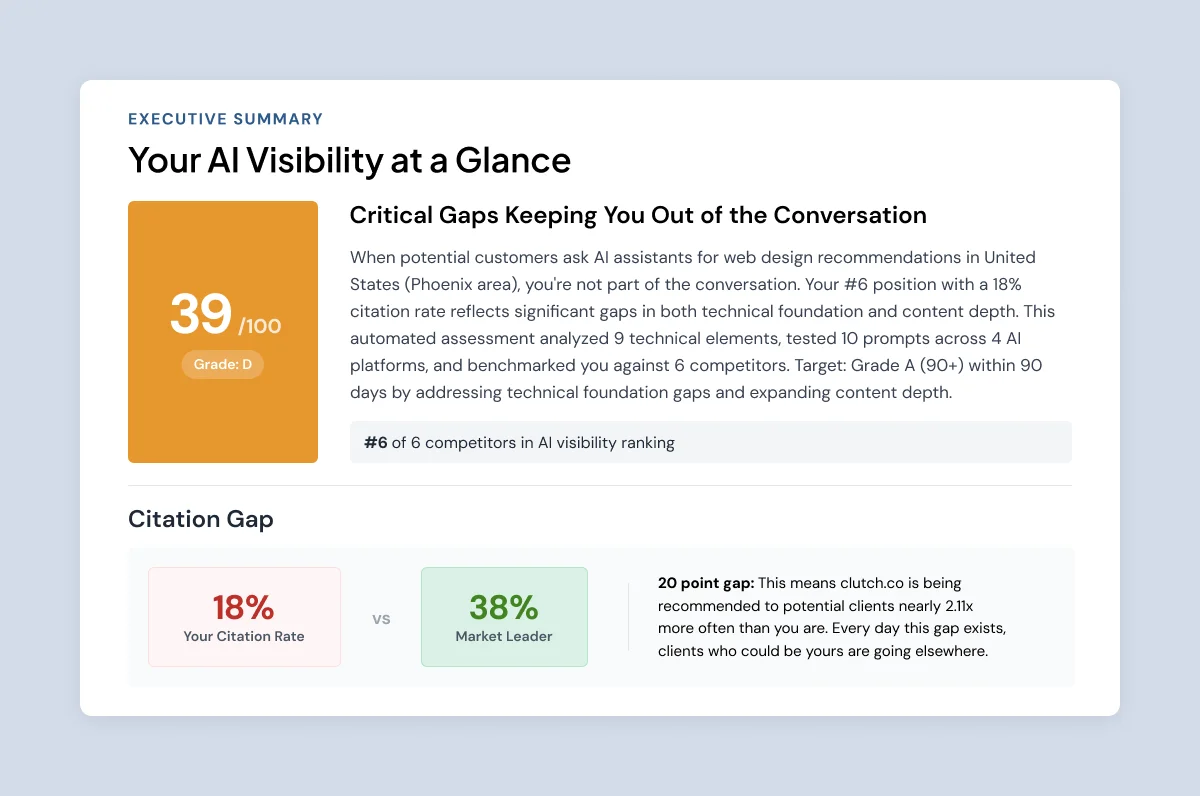
Business owners don’t read 50-page reports front to back. They skim. They flip to the summary. They want the key insights on what matters before they invest time in the details. The executive summary gives them exactly that.
This page includes the overall AI visibility score (0-100 with a letter grade), a plain-language assessment of where the business stands, and the citation gap versus the top competitor, shown as both a percentage and a multiplier so clients can immediately see where they stand. It also covers how many competitors were analyzed, how many prompts were tested, and which platforms were included.
The grade reflects three factors: the technical foundation of the website (can AI platforms actually crawl and understand it?), citation performance across platforms (how often is the business being recommended?), and proprietary weighting based on what we’ve seen move the needle in real client engagements.
Important Note: This is a sampling of prompts, not a comprehensive analysis of every possible search query. It’s enough to identify patterns and gaps, but deeper prompt coverage (which we’ll talk about in the citation testing section) gives you a fuller picture.
Why the citation gap matters
The citation gap is an important number on this page. It tells the client whether they’re being recommended more or less often than their closest competitor across AI platforms. A 25-point gap in either direction tells a clear story. One that clients grasp immediately without needing a technical explanation.
The top three improvement opportunities round out the summary. They set the agenda for the rest of the conversation. You don’t need to walk through every page. Focus on the three findings that matter most, and let the client explore the rest at their convenience.
Pro Tip: The AI Visibility Audit report works best when presented as a proposal. Walk the client through it on a screen share or sit across from them with it open. Emailing a report this detailed and hoping they read it on their own rarely produces the same result. The executive summary gives you the perfect opening: 30 seconds of headlines that pull the client into a deeper conversation.
The AI Search Landscape
Most business owners have never considered whether they appear on ChatGPT. They’ve heard of it. They might even use it personally. But the idea that potential customers are asking AI platforms for business recommendations? That’s new territory. After 25 years in this space and building over 100,000 audits with agencies through My Web Audit, I haven’t seen a new discovery channel emerge this fast since mobile search.
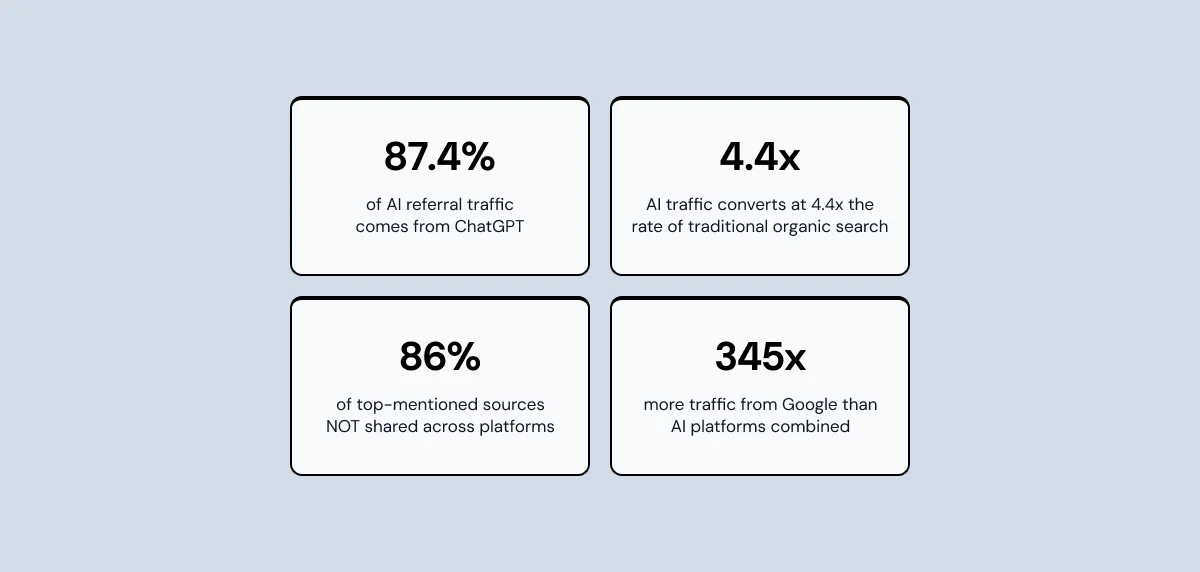
Before the rest of the report makes sense, clients need context. How is AI search actually changing the way consumers find businesses? What does the data say? This section answers those questions with current research: 87.4% of AI referral traffic comes from ChatGPT1, AI-referred visitors convert at 4.4x the rate of traditional search2, and AI-referred traffic has grown 1,200% year-over-year3.
How AI visibility relates to traditional SEO
Here’s the thing: there’s a stat in this section that might seem counterintuitive for a report about AI visibility. Google still drives 345x more traffic than all AI platforms combined4. It’s included deliberately.
Without that number, the AI visibility conversation can spiral in the wrong direction. Clients with an existing SEO strategy might think they need to abandon it and chase ChatGPT rankings instead. Clients without one might think AI visibility is the only thing that matters now. Neither is true.
The report’s framing is clear: SEO is the foundation. AI visibility is an emerging growth layer built on top of it. For clients already investing in SEO, this is additive. For clients who haven’t prioritized search yet, the report makes the case for both, starting with the fundamentals.
Every stat in this section has a cited source. This matters when a business owner asks, “Where are you getting these numbers?” You’re presenting research, not marketing copy.
AI Platform Snapshot: Four Platforms, Different Stories
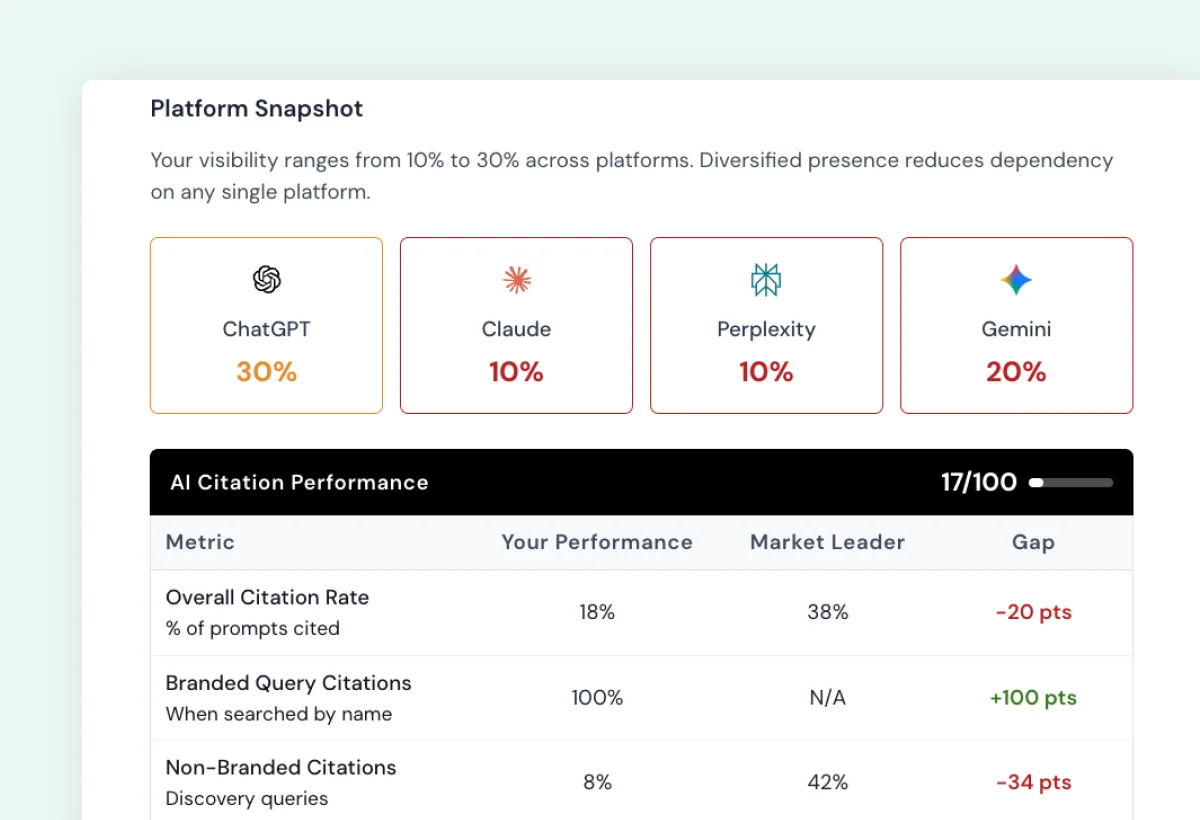
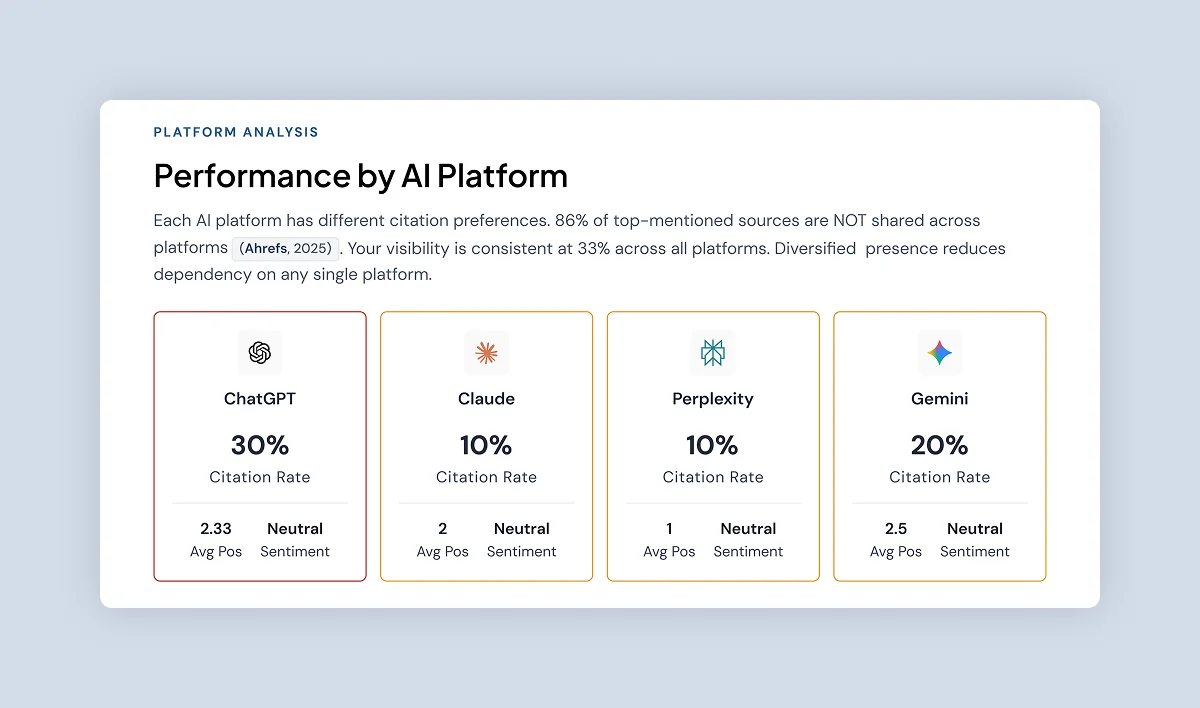
AI platforms don’t share citation preferences. Research from AHREFS analyzing 78.6 million interactions5 found that 86% of top-mentioned sources are unique to a single platform. What that means in practice: a business can perform well on Claude and be completely invisible on ChatGPT, where the vast majority of AI referral traffic originates.
You get individual visibility scores for ChatGPT, Claude, Perplexity, and Gemini. For each platform: citation rate, average position, and sentiment, displayed in a visual card layout for quick side-by-side comparison.
Sentiment adds a layer most agencies miss
Showing up in AI results matters. But showing up with the wrong tone can backfire. The report tracks whether AI platforms use endorsement language, neutral listing, or cautionary language when mentioning the business. A citation paired with negative sentiment can hurt more than no citation at all.
The platform-by-platform view makes the data actionable. If ChatGPT is weak but Perplexity is strong, you know where to focus first. And you can explain why.
Pro Tip: When presenting this section, start with ChatGPT. It accounts for most AI referral traffic, so it’s where most clients should focus first. But don’t skip the other platforms entirely. Perplexity users tend to be early adopters and researchers, and Gemini is tightly integrated with Google’s ecosystem. Each platform has a different user profile worth mentioning.
Citation Testing
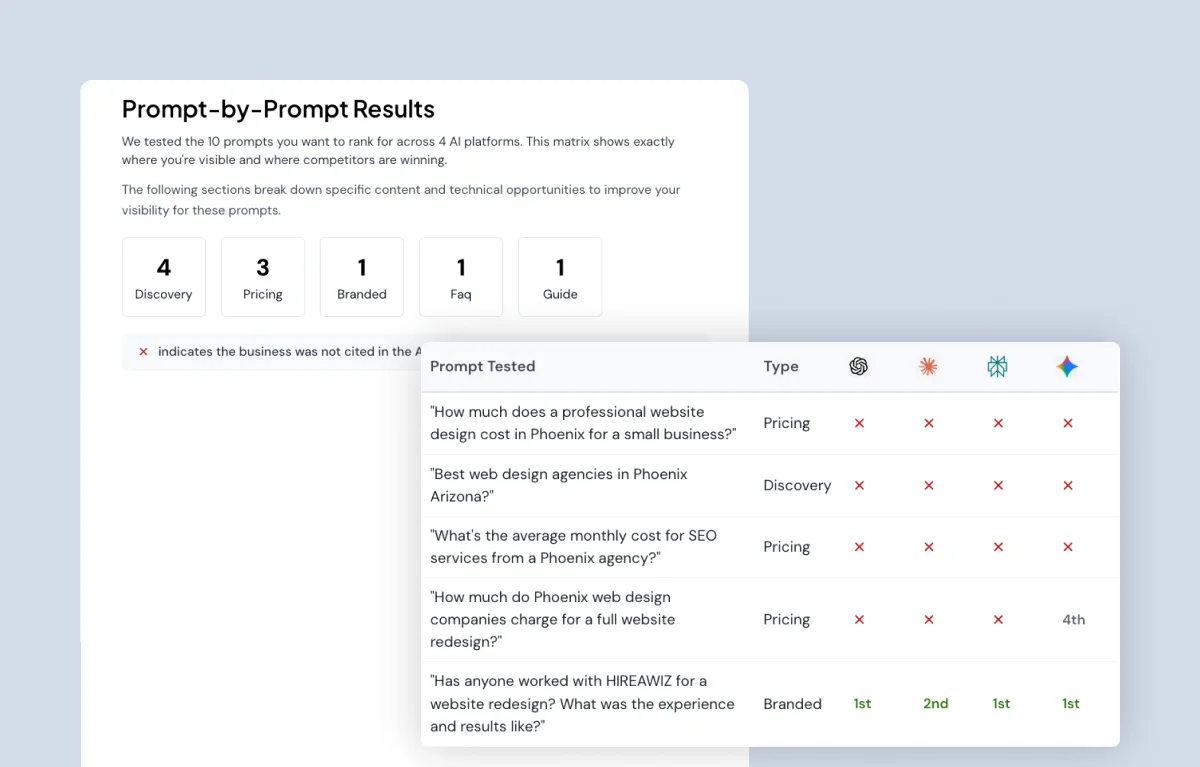
This is the section where AI visibility stops being abstract and starts being measurable. It answers the question every business owner will have: “When someone asks ChatGPT for my service in my city, what happens?”
A matrix of prompts is tested across all four AI platforms. For each prompt, you see the citation position (1st through 6th, or not cited) on every platform.
Important Note: These results come from live searches run at the time of the audit, not cached data. AI platforms update their responses frequently, so the audit captures a real-time snapshot of the business’s current state.
Prompt types and what they reveal
Different prompts test different stages of the buyer journey. The audit includes a mix, and these are just some of the types you can test:
Local queries test whether the business appears in location-specific searches. Examples: “best plumber in Scottsdale,” “top-rated dentist near downtown Phoenix,” “HVAC repair in Phoenix AZ.”
Discovery queries test how the business appears when someone is exploring options. Examples: “how to choose a roofing contractor,” “what to look for in a family law attorney,” “questions to ask a retinal specialist during an appointment.”
Comparison queries test whether the business is mentioned as buyers narrow their choices. Examples: “local vs chain auto repair shops,” “boutique marketing agency or large agency,” or “independent financial advisor vs bank advisor.”
Problem-based queries test whether the business shows up when someone describes a symptom or challenge. Examples: “my AC is blowing warm air,” “website not showing up on Google,” “foundation cracks in Arizona homes.”
Each platform handles these prompts differently. ChatGPT tends to favor authoritative, well-structured content. Perplexity leans heavily on recent sources and citations. Claude weighs expertise signals. Gemini pulls from Google’s index and knowledge graph. The same business can rank first on one platform and be absent on another, which is why testing all four matters.
Why prompt selection matters as much as the results
If you’ve done traditional SEO for any length of time, you know that the keywords you choose to track shape the story your data tells. Track branded terms, and your rankings look great. Track high-competition terms, and you might look invisible. The same principle applies here.
A prompt like “best plumber in Scottsdale” produces a very different citation landscape than “emergency pipe repair near me.” Some prompts are the AI equivalent of branded search. Others are highly competitive discovery prompts in which dozens of businesses compete for the same citation spot. The audit includes a mix deliberately. If every prompt were easy, the results would look artificially good. If every prompt were hyper-competitive, it would look discouraging. The blend gives an honest picture.
The prompts are editable, and that matters. When you run an audit, we provide a suggested list of prompts based on your business type and our understanding of it. You can edit, add, or remove prompts before generating the report. The default set is a starting point, not the full picture. To get a real understanding of a brand’s AI visibility, you’ll want to add 20-30+ prompts covering the full range of services, locations, and question types their customers actually ask. Think of it the same way you’d think of a first-pass keyword audit in SEO. It gives you enough for a meaningful conversation and identifies the biggest gaps. The deeper you go with prompt coverage, the more specific your recommendations become.
Pro Tip: Match your prompt depth to the stage of the relationship. For a prospect you’re trying to close, the default prompts are enough to show gaps and spark a conversation. For a paying client, invest the time to build out 30+ prompts that cover their full service area and buyer journey. That deeper analysis justifies ongoing retainer work.
Important Note: You may see other tools claiming to show “prompt volume” or search volume for AI queries. That data doesn’t exist. None of the major AI platforms have made query volume public, and they likely won’t for a while, if ever. Anyone claiming otherwise is using marketing hype and estimated numbers. Focus on testing prompts that reflect how real customers actually search, not chasing volume metrics that can’t be verified.
The “Who’s Winning” competitive breakdown
The competitive intelligence in this section gets specific fast. You can show a client that their competitor’s service page, product page, or blog post is getting cited on three platforms for a specific prompt. And here’s the exact URL AI is pulling from.
That level of detail gives you two things: it shows clients which content is winning, and it provides a concrete starting point for recommendations. You’re pointing to a specific page on a specific platform for a specific query.
This section benefits most from a live walkthrough. When you pull up the citation matrix on screen and a client sees their competitor appearing across three platforms while their own business is absent, that feels different from reading it in a PDF.
Citation position matters too. When AI platforms recommend businesses, they typically rank them by relevance or authority. Being recommended first in an AI response carries significantly more weight than being mentioned sixth. The first few positions get the click. The sixth position may not even be read and gets skipped.
Pro Tip: Not every citation is a competitor. The audit also surfaces non-competitor sites that are getting cited for the same prompts: review sites like Yelp or G2, industry directories, local business listings, news outlets, and resource roundup pages. These are potential backlink opportunities. If AI platforms trust these sources enough to cite them, earning a link or mention there can strengthen your client’s authority for both traditional SEO and AI visibility.
Traffic Analysis: Using Real Data to Tell the Story
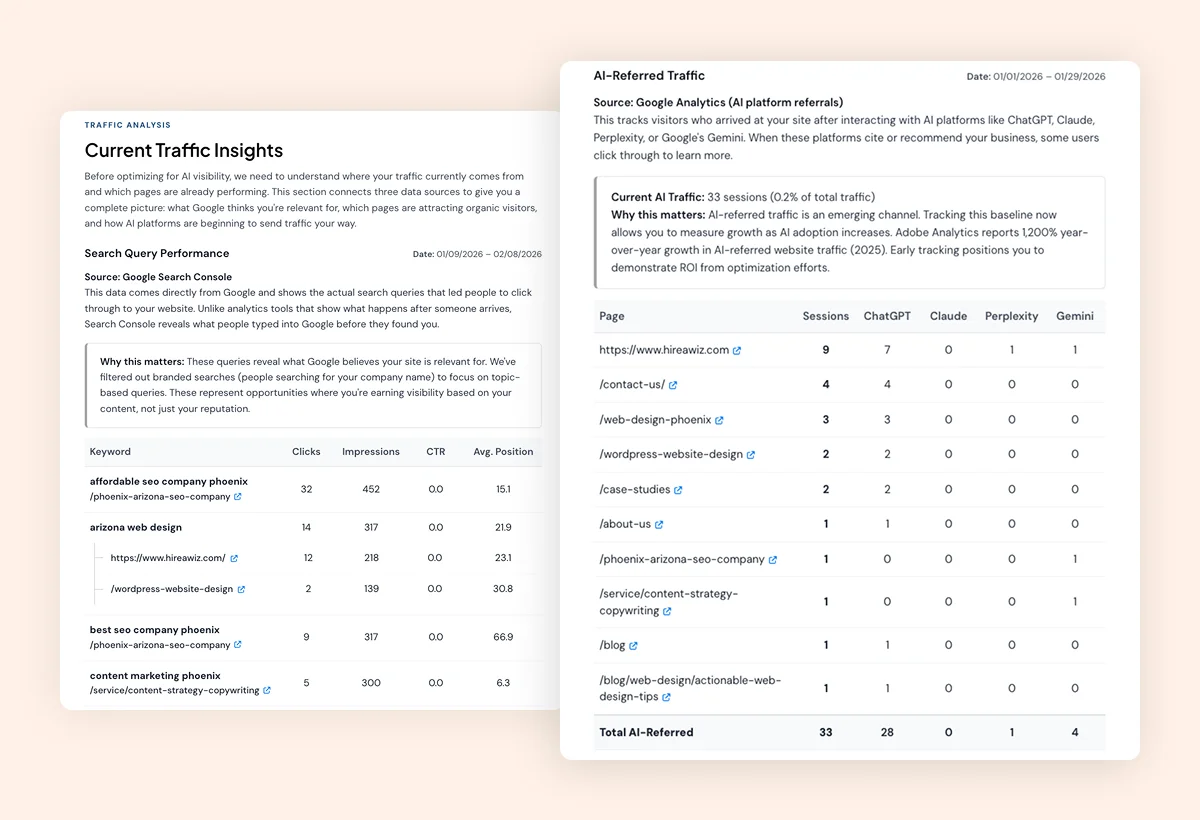
Many AI visibility conversations remain theoretical. “You could be showing up on ChatGPT or Google.” “AI traffic is growing.” This section grounds the conversation in the client’s actual traffic and analytics data.
When running an audit for a website with access to Google Search Console and Google Analytics, the audit pulls those insights directly into the report, adding context and value that generic audits can’t provide.
If a client doesn’t grant access to Google Analytics or Search Console, this entire section is removed from the report. It’s worth pushing for that access early. The traffic data adds significant value and insight and, more importantly, establishes an accurate baseline. That baseline is essential for measuring progress on both traditional SEO and AI visibility services. Without it, you’re guessing at impact instead of proving it.
Google Search Console: what’s actually driving clicks
From Google Search Console, you see the actual search queries driving clicks, which pages they’re landing on, impressions, click-through rate, and average positions. We generally exclude branded terms so the focus stays on non-branded keyword opportunities, the ones where there’s real room to grow.
Search Console data reveals what Google already considers the site relevant for. Those queries are the starting point for AI optimization. If Google ranks a site for a term, AI platforms are more likely to cite it in response to related prompts. Your client’s top organic pages are the strongest candidates for AI visibility improvements because they’ve already proven to be relevant.
Google Analytics: organic traffic only
From Google Analytics, we filter to organic traffic only. This keeps the data clean and avoids muddying the picture with visits from email campaigns, direct traffic, paid ads, or other sources. You’re seeing how the site performs in search specifically.
AI-referred traffic: segmented and simplified
The report also segments AI-referred traffic by platform and landing page. If you’ve tried to do this manually in Google Analytics, you know it’s a pain. The audit handles that filtering and presents it in a format that’s easy to understand and easy to show a client.
Establishing a measurable baseline
AI-referred traffic establishes a number that the client can track over time. For most businesses right now, that number will be small. That’s expected. With AI traffic growing 1,200% year-over-year3, even a small baseline gives you something to measure against.
Important Note: Not all AI traffic is trackable. Some visits show up as “Direct” when platforms don’t pass referral data. The numbers are a conservative floor, not a ceiling. Being upfront about that builds trust.
Pro Tip: Quick-win opportunities usually involve optimizing what’s already getting traffic. Use Google Search Console and Google Analytics data to see what’s ranking and driving visits. Look at what’s already getting traffic from AI platforms and find ways to improve it or add similar types of content to strengthen it. You’re building on proven relevance, not starting from scratch.
Technical Visibility Scorecard: Elements AI Platforms Look For
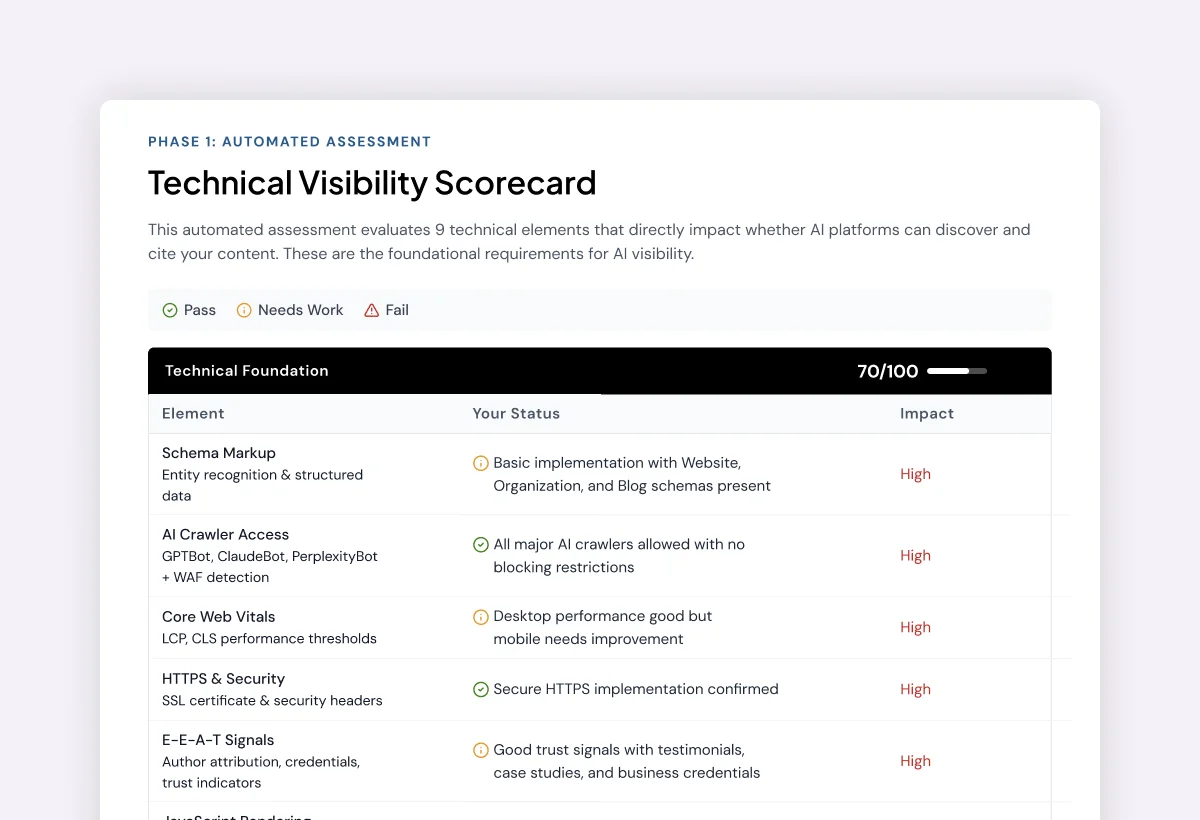
An optimized website is more important than ever for a brand’s visibility online. Strong content on a technically broken site won’t get cited. This is true for Google and for AI platforms. The difference is that AI crawlers are often less forgiving. They’re looking for structured, accessible content they can parse quickly and confidently.
This section checks whether the site’s technical setup actually allows AI platforms to find, read, and trust the content. Each element gets a pass / needs work / fail assessment with an impact rating of High or Medium.
The nine elements covered: Schema Markup, AI Crawler Access, Core Web Vitals, HTTPS & Security, E-E-A-T Signals, JavaScript Rendering, llms.txt File, XML Sitemap, and Semantic HTML Structure. Together, they produce a Technical Foundation score from 0 to 100.
Important Note: Different SEO professionals may weigh some of these signals differently, and that’s expected. This is what we’ve found to work based on our experience and testing. As both traditional SEO and AI search continue to evolve, these elements and their relative importance will likely shift too. We’ll update the audit as the landscape changes.
Where traditional SEO and AI visibility overlap
Most of these elements will look familiar if you’ve done technical SEO work. Schema markup, Core Web Vitals, HTTPS, XML sitemaps, and semantic HTML: these have been SEO fundamentals for years. The good news is that fixing them improves both Google rankings and AI visibility.
A few elements are AI-specific. AI Crawler Access checks whether robots.txt blocks AI crawlers such as GPTBot, ClaudeBot, or PerplexityBot. The llms.txt file is a newer standard that gives AI platforms explicit instructions about your content. These won’t directly affect Google rankings, but they can make the difference between being cited by AI platforms and being invisible to them.
The two highest-impact elements
Schema markup and AI crawler access carry the most weight. Schema tells AI platforms what the business is, what it does, and where it operates: structured data they can parse in seconds. Crawler access is even more fundamental. It determines whether AI platforms can read the site at all. If the robots.txt blocks AI crawlers, nothing else in the optimization conversation matters until that’s fixed.
The llms.txt file is relatively new, and most businesses don’t have one yet. It provides AI crawlers with specific instructions on content preferences and usage permissions. But a generic llms.txt doesn’t do much. The value comes from pointing AI platforms to the signals that matter: the about page, author bios, credentials and certifications, case studies, testimonials, service pages, and any content that demonstrates E-E-A-T. Think of it as a guided tour for AI crawlers, showing them exactly where to find the trust signals that make the business worth citing.
Quick win. Its absence isn’t a failure, but adding a well-structured one takes minutes and signals to AI platforms that the site is ready to be cited.
E-E-A-T Signals: Where Most Businesses Are Falling Short
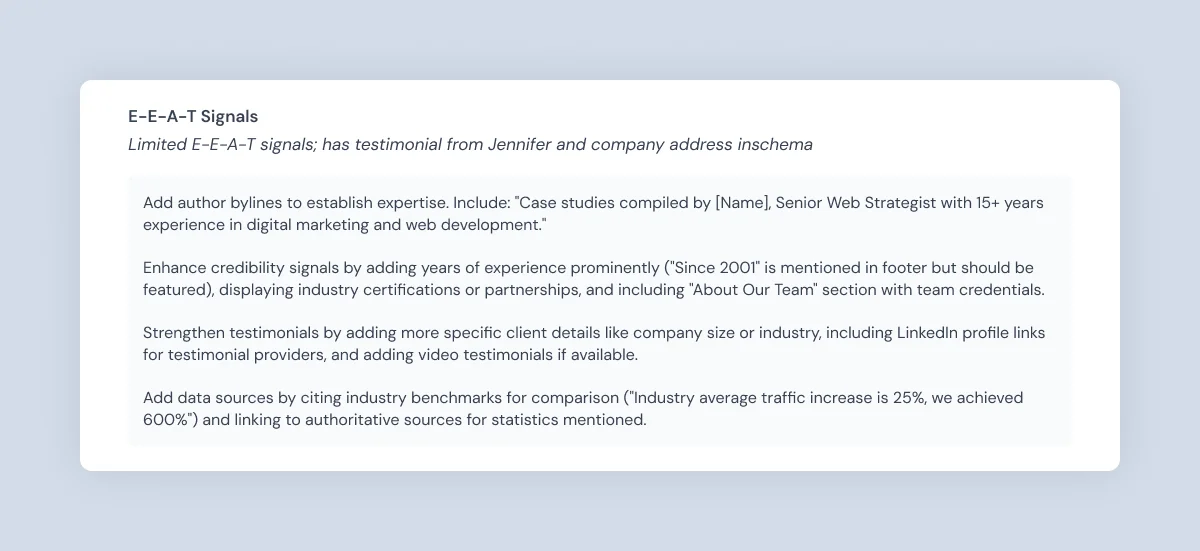
E-E-A-T (Experience, Expertise, Authoritativeness, Trustworthiness) matters more for AI citation than most agencies their clients realize. This is where we see the biggest gaps, and it’s often the difference between getting cited and getting ignored.
You wouldn’t believe how many businesses fail to include basic trust signals on their websites. They’ve been in business for 20 years but never mention it. They have industry certifications hanging on the wall, but not on the website. They offer a satisfaction guarantee, but bury it in the fine print. They have a unique process that sets them apart, but they’ve never documented it anywhere that a customer (or AI platform) can find it.
AI platforms are trying to answer a simple question: Should I recommend this business? To answer that, they need evidence. Not claims. Evidence. And that evidence comes from a combination of sources that most businesses haven’t considered optimizing.
Content signals
Written content that demonstrates real expertise: detailed service pages, educational blog posts, FAQs that answer real customer questions, and content with named authors who have visible credentials. AI platforms look for depth, specificity, and attribution. A 300-word service page with no author doesn’t give them much to work with.
This is also where businesses should be clear about what they specialize in, how long they’ve been doing it, and what makes their approach different. A plumber who has specialized in older homes for 15 years has a story to tell. A law firm with a unique intake process that reduces client stress has something competitors don’t. These details matter for AI citation because they give platforms something specific to recommend.
Pricing transparency helps too. Businesses that list starting prices, package options, or “projects typically range from X to Y” give AI platforms concrete information to share. When someone asks, “How much does a kitchen remodel cost in Phoenix?” the business that provides real numbers is more likely to get cited than the one that just says “contact us for a quote.”
Media content
Reviews, ratings, and third-party validation. Google Business Profile reviews, industry-specific review sites, and testimonials are structured on the website where AI crawlers can find them. These signals tell AI platforms that real customers have worked with this business and had positive experiences.
Awards and certifications belong here, too. Industry recognitions, Better Business Bureau ratings, professional association memberships, and manufacturer certifications. These third-party validations carry weight because they’re harder to fake. If a business has them, they should be visible and structured for AI discovery.
Rich media
Video testimonials, case studies, podcast appearances, conference talks, and published articles. These demonstrate that the business has experience beyond just a website. A video of a client explaining how the business solved their problem carries more weight than a text testimonial. A case study with real metrics shows expertise in action.
Guarantees and unique processes are powerful here. A roofing company that offers a 10-year workmanship guarantee and documents its 47-point inspection process on video is giving AI platforms something concrete to cite. These aren’t just marketing claims. They’re differentiators that AI can surface when someone asks, “What should I look for in a roofer?”
Why this matters more than most agencies realize
Most businesses have some of these signals scattered across the internet. The problem is that AI platforms can’t always find them, connect them, or understand they belong to the same business. The audit evaluates what’s already in place, flags what’s missing, and identifies opportunities to make existing E-E-A-T signals more visible and structured for AI discovery.
The pass/fail format in the technical scorecard is intentional. Business owners don’t need to understand the mechanics. They need to see green, yellow, or red. And trust that you know what to do about it.
Pro Tip: Avoid gating E-E-A-T content whenever possible. If a business has case studies locked behind a PDF download or a testimonial video on Vimeo that requires a click to play, AI platforms can’t access that content. Transcribe videos and publish them as web pages with the video embedded. Convert PDF case studies to dedicated pages with proper schema markup. The content already exists. Make it visible to AI crawlers, not hidden behind forms and file downloads.
Content and Page-Level Analysis
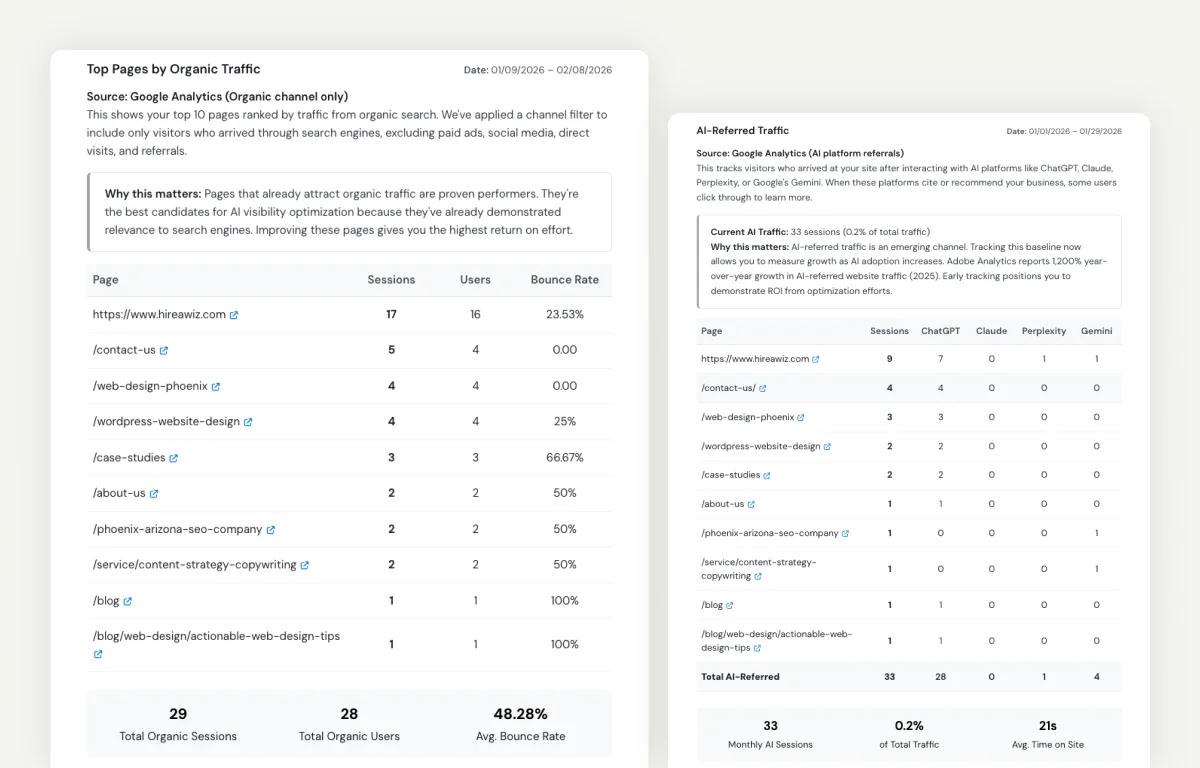
This section gets specific. Really specific.
When analytics are connected, we use that data to identify which pages matter most: the ones already getting traffic, the ones ranking for valuable terms, and the ones where small improvements could have an outsized impact. Citation data from the audit adds another layer, showing which pages (yours or competitors’) are actually getting recommended by AI platforms for specific prompts.
From there, we evaluate content optimization opportunities based on the data. Each priority page gets a content depth assessment: current word count versus recommended target, specific sections to add, and schema markup recommendations with actual JSON-LD code examples. Service, LocalBusiness, and FAQ schema that your team can implement directly without writing code from scratch.
The report also highlights quick wins: pages that are close to performing well but need minor adjustments. Maybe a service page is ranking on page two for a valuable term and just needs 300 more words and proper schema. Maybe a blog post is being cited on Perplexity but not on ChatGPT, and adding author credentials could close that gap. These are low-effort, high-impact opportunities that justify immediate action.
Recommendations built on what already exists
The E-E-A-T recommendations are tailored to the business’s current situation. Board-certified professional on staff? The report recommends making those credentials more visible and structured for AI discovery. Client testimonials scattered across review sites? It recommends structuring them on-site, where AI crawlers can find them. You’re strengthening what’s there, not starting from zero.
A 400-word service page with no schema is easy for AI to overlook. A 1,500-word page with proper schema, author attribution, and deep topical coverage is much harder to skip. The report spells out that gap for each priority page. Specific targets with specific additions, not a vague “improve your content” note.
Content freshness is another consideration, though it’s typically addressed in the next stage during optimization and ongoing SEO or AI visibility services. Which pages haven’t been updated in a year? Which are losing ground to competitors with newer, deeper content? These questions inform the ongoing strategy, not the initial audit.
Pro Tip: If a prospect or client balks at the audit or implementation investment, remind them how long it would have taken to uncover these insights if they even knew what to do. Hours of research across multiple AI platforms, competitor analysis, technical audits, and analytics review, all synthesized into a clear picture of where to focus. The audit doesn’t just identify problems. It shows you where, what, and why to implement AI and SEO optimization. That strategic clarity is where the real value is. Implementing it when they realize the business impact of more visibility, leads, customers and revenue.
Performance Analysis: Page Speed and AI Crawling
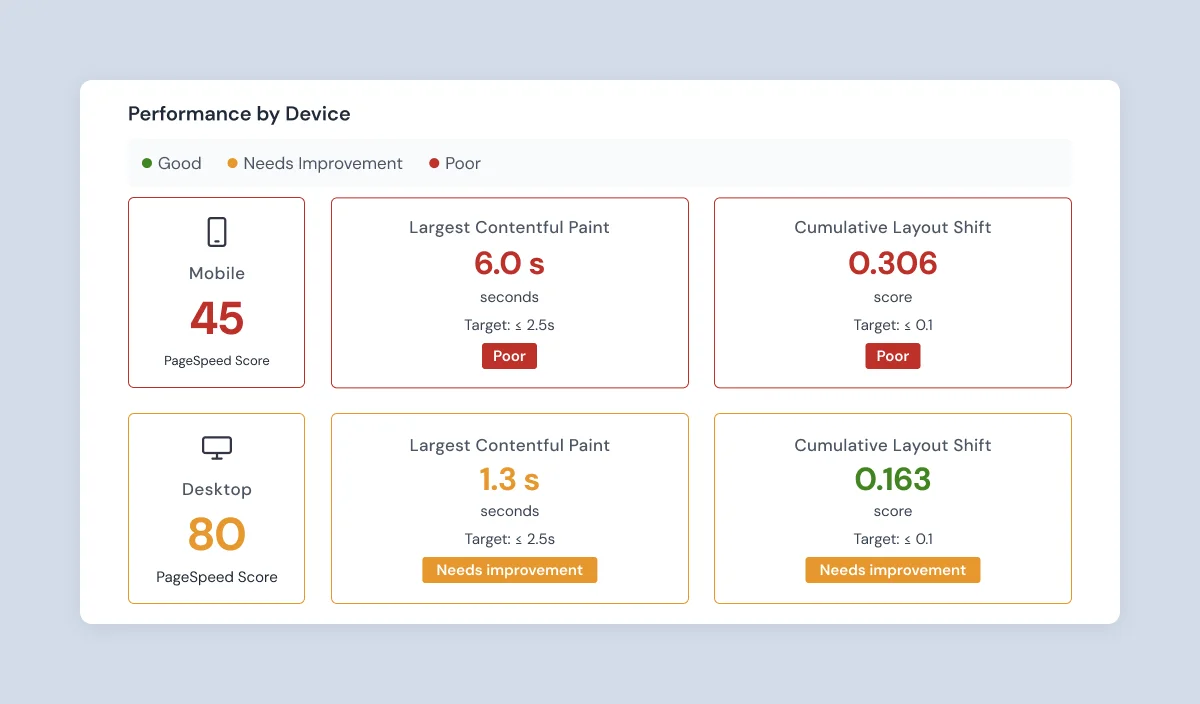
Page speed impacts three things at once: user experience, SEO, and AI visibility. Slow sites frustrate visitors, rank lower in Google, and are crawled less frequently by AI platforms, which means less content is available for them to cite. This section pulls mobile and desktop PageSpeed scores along with LCP and CLS, measured against Google’s thresholds.
The business impact framing helps clients connect a technical metric to revenue. 53% of mobile visits are abandoned when load times exceed three seconds6, and 70% of consumers say page speed impacts their willingness to buy7.
Why are mobile and desktop scores scored separately?
The gaps between mobile and desktop can be significant. A site scoring 95 on desktop and 62 on mobile has a problem that affects search rankings, AI crawling, and the experience for most visitors arriving on phones.
Pro Tip: If a client pushes back on page speed improvements, point to the mobile score specifically. Most of their visitors are on phones, and most AI queries happen on mobile devices. A slow mobile experience hurts both channels.
Investment Case and Next Steps
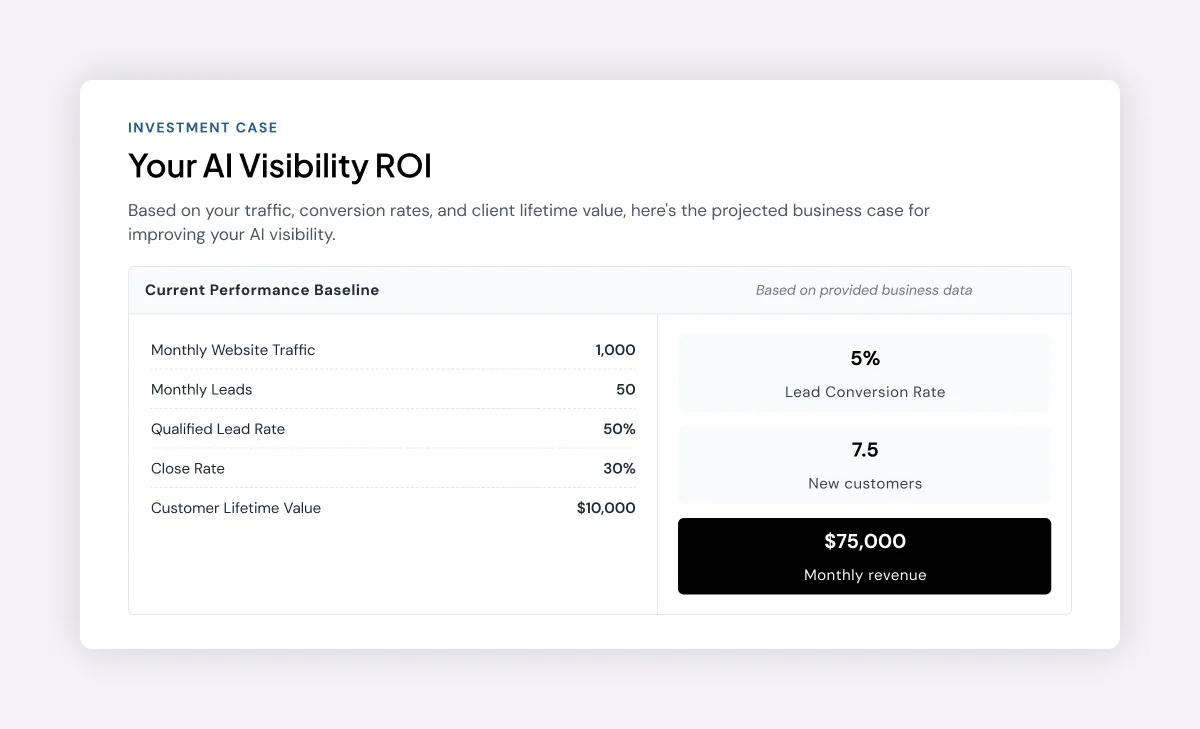
By the time a client reaches this section, they’ve seen the full picture. Their score, gaps, competitors, and specific fixes. This section connects those dots to projected outcomes.
The ROI section
The audit includes an ROI section that, when completed, presents a strong case for the return on investment of your services. This is where the conversation shifts from “here’s what’s broken” to “here’s what fixing it is worth.”
We recommend filling this out before presenting the report. If you have the client’s data (average customer value, close rate, monthly leads), use it. If not, ask them during a discovery call. If they don’t have the information or aren’t willing to share it, provide a conservative baseline estimate for their industry. Either way, you’re giving them a realistic understanding of ROI and establishing a baseline you can measure against.
The ROI section also includes a field for the cost to fix foundational website issues. This is the one-time project work (technical fixes, schema implementation, etc.) that needs to be completed before the ongoing retainer services begin; some agencies include this as part of the first month or two of the retainer. The choice is yours; adjust this based on your pricing, service model, and the scope of work revealed by the audit.
For agencies that don’t focus on SEO
If SEO isn’t your core service, this is an opportunity to productize. Offer the foundational optimization as a fixed-scope project: the technical fixes, schema markup, content updates, and AI visibility improvements identified by the audit. Then partner with a white-label SEO provider for the ongoing retainer work. You stay in the client relationship, deliver the strategy, and let a specialist handle the month-to-month execution.
The compounding framework
The compounding framework is straightforward: every technical fix and content improvement that helps traditional SEO, like Google rankings, also improves AI visibility. One strategy. Two channels. That’s an easier conversation than asking a client to fund something entirely new.
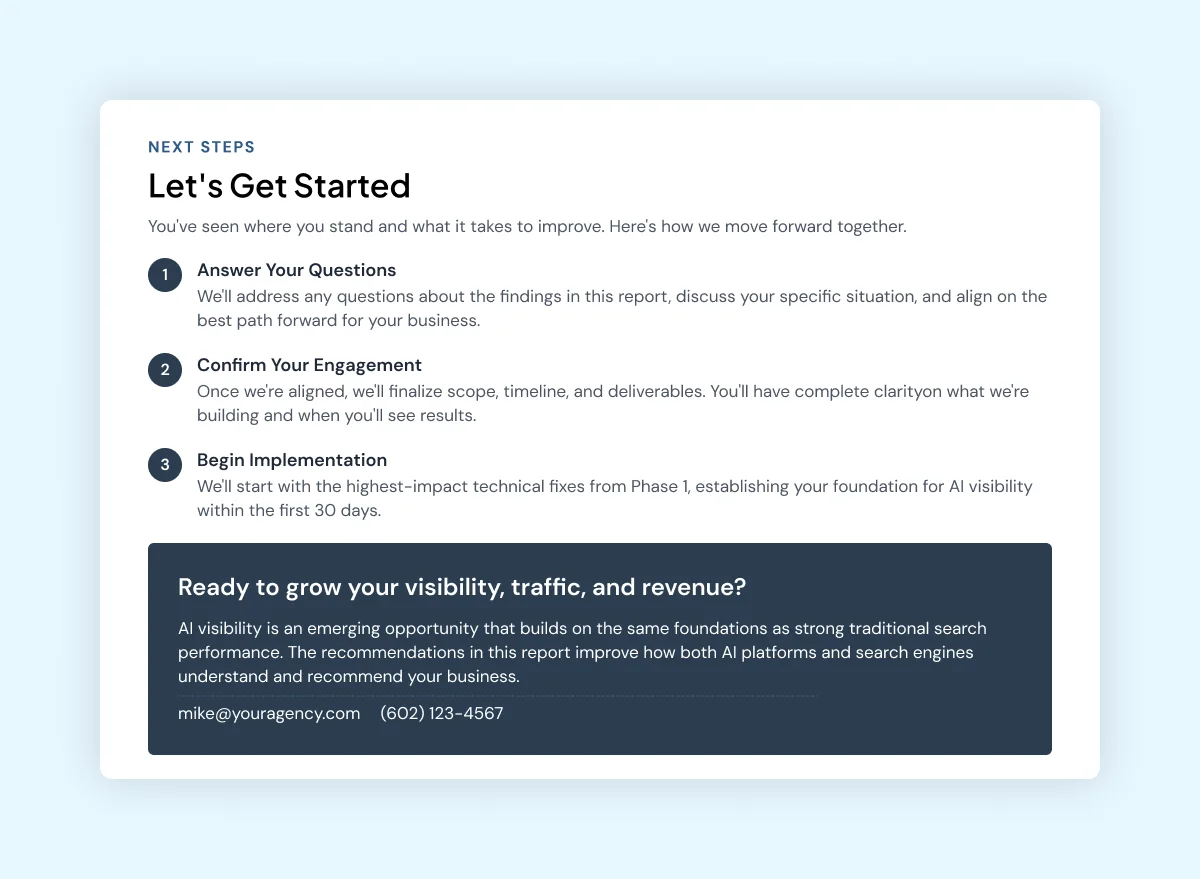
Next steps keep things simple: answer questions, confirm engagement, and begin implementation. No pressure. The report has already made the case through data, and the client can move at their own pace.
Pro Tip: Use this section to set expectations on both ROI and timelines. The ROI data should make it clear that the business can expect multiple returns on its investment in your services, making this a sound business decision rather than an expense. On timelines, be realistic: quick wins (technical fixes, schema implementation, basic content updates) can show results in 30-60 days. But meaningful traffic growth and measurable impact on AI visibility typically take 3-6+ months, depending on the business, level of competition, and industry. Setting these expectations upfront builds trust and prevents frustration down the road.
How This Audit Differs From Traditional SEO Audits
If you already use My Web Audit to run website audits or deliver SEO audits, you might be wondering where this fits.
A few key differences.
The AI Visibility Audit tests actual AI platforms with real prompts. ChatGPT, Claude, Perplexity, and Gemini were all queried with prompts that reflect how real users search. No proxy scores based on SEO factors alone.
Competitor detection is automated based on what AI platforms actually cite, not manually selected by the agency. That means you’re seeing who your client is really competing against in AI results. And those competitors may differ from the ones ranking on Google.
Citation testing reveals who gets recommended for specific queries. That’s a different question from who ranks on Google for those terms. The report delivers specific, actionable insights with every stat research-backed and cited.
A report built for a client presentation
The final AI Visibility Audit report is a branded document designed for client presentation, not a lightweight summary you’d email as a teaser. The depth is deliberate. There’s enough actionable intelligence in a single report that many agencies charge $500-$1,500 for it as a standalone paid deliverable and consultation to cover it and answer questions. Some use it as the foot-in-the-door offer that leads to $2,000-$10,000 implementation engagements. Others bundle it into a discovery or strategy package. Either way, the report carries enough weight to justify its own price tag.
Your agency’s name goes on it. Your branding. Your expertise. When you’re using this audit to open a conversation about implementation work (technical fixes, content strategy, ongoing AI visibility management), that positioning makes a difference.
The Report Is the Starting Point
The AI Visibility Audit report is thorough, and every section pulls its weight. Each one gives you something specific to talk about with a client, recommend to a client, or hand off to your team to execute.
Present it like a proposal. Walk clients through the highlights on a call or in person. Let the depth of the report reinforce your expertise without you having to sell it. Clients who receive this level of analysis from their agency typically don’t shop around for a second opinion.
AI visibility is still early enough that most businesses haven’t addressed it. The agencies working on it now have an opportunity to show clients something they haven’t seen before: clear insights backed by data, without the hype that makes business owners skeptical.
Frequently Asked Questions
These are the questions I get most often from agencies evaluating the AI Visibility Audit or figuring out how to position it with clients. If you’re wondering how to price it, when to use it, or how it fits into your sales process, start here.
Should I present the report live or email it?
Present it. Every time. A detailed report emailed without context ends up in a “read later” folder that never gets opened. When you walk a client through the highlights on a screen share or in person, you control the narrative. You can pause on the findings that matter most, answer questions in real time, and transition naturally into “here’s what we recommend.” The report is a conversation tool, not a PDF to attach and hope for the best. Conversations lead to closed deals!
What should I charge for an AI Visibility Audit?
That depends on how you’re using it and who you serve. Agencies charge anywhere from $250 to $1,500 for the audit as a standalone deliverable, or as part of consulting and a set of implementation hours. The depth of the report supports the price points. Other agencies use it differently: they run the audit for free (or at a low cost), leading with value when they present it live to close implementation and retainer deals worth $2,000 to $10,000 or more. The audit becomes the foot-in-the-door, not the product itself. Match your pricing strategy to the relationship stage: free for leads to open doors, bundled into paid discovery for warm prospects, and packaged into monitoring and monthly service retainers for existing clients.
Is this audit meant for lead generation?
No. The AI Visibility Audit is designed for use in a sales process, consulting engagement, or as a paid deliverable to qualified leads, prospects, and customers. It’s too detailed and valuable to give away at the top of the funnel. Use it when you’re sitting across from someone who’s ready to have a real conversation about their business, not as a form fill on a landing page.
For lead generation and conversation starters, we’ll offer a separate lead magnet built for that purpose: enough value to capture interest without giving away the full analysis. The AI Visibility Audit is what you present after you’ve earned the meeting.
How long does the audit take to run?
The audit runs in 5-10 minutes, not hours. Once you input the URL and customize the prompts, the system queries all four AI platforms, pulls analytics data (if connected), and generates the full report. What would take hours to do manually is handled automatically. Your time goes into reviewing the findings and preparing your presentation, not into gathering or analyzing data.
How often should I run a new audit for a client?
AI visibility changes fast. What works today may shift as platforms update their models and citation preferences. We recommend running a new audit after 30, 60, or 90 days, depending on the engagement. Use the same prompts each time so you’re comparing apples to apples and can clearly show progress (or identify new gaps).
For clients on implementation retainers, these periodic audits give you fresh data to justify ongoing work. For one-time engagements, offer a follow-up audit at a reduced rate to keep the door open.
We’re also launching a monthly AI visibility client report that can be offered as a standalone product or bundled with your fulfillment services. It gives clients ongoing visibility into their progress without requiring a full audit each time.
Can I white-label the report with my agency’s branding?
Yes. The report is fully branded with your agency’s logo, colors, and contact information. When you present it to a client, it looks like your deliverable rather than a third-party tool. That positioning matters when you’re using the audit to establish expertise and close implementation deals.
Ready to run your first AI visibility report?
If you’re not already using the AI Visibility Audit, the best way to understand its value is to run one yourself on your agency. See what the report looks like, how the data is presented, and how you’d walk a client through it.
Start your free trial of My Web Audit and run your first AI Visibility Audit today. No credit card required to get started.
Already a My Web Audit user? The AI Visibility Audit is available on Studio and Agency plans. Log in and run your first audit now.
Stay connected
If you want to keep learning about AI visibility, agency growth, and how to get more value from your audits, here’s where to find us:
Subscribe to our YouTube channel for walkthroughs, tutorials, and tips on presenting audits that close deals. We regularly publish content on AI visibility, SEO, and agency sales strategies. Subscribe on YouTube
Sign up for our email list to get updates on new features, templates, and resources. We’ll also share what’s working for other agencies so you can learn from their wins. Join the email list
Join the agency conversation in our Facebook group. Connect with other agency owners and freelancers who are using audits to grow their businesses. Ask questions, share what’s working, and get feedback from the community. Join the Facebook group
References
- “The State of AI-Driven Search Traffic.” Conductor, 2026. conductor.com
- “AI Search Conversion Benchmarks.” Semrush, 2025. semrush.com
- “Digital Trends: AI Referral Traffic Growth.” Adobe Analytics, 2025. business.adobe.com
- “Google vs. AI Platform Traffic Analysis.” Dataslayer, 2025. dataslayer.ai
- “AI Citation Patterns Across Platforms.” Ahrefs, 2025. ahrefs.com
- “Mobile Page Speed and User Behavior.” Google. thinkwithgoogle.com
- “Consumer Expectations: Page Load Times.” Statista, 2024. statista.com

About Clifford Almeida
You may also like
AEO Prompt Strategy for Agencies: How to Find, Choose, and Track the Right AI Prompts
Right now, your client’s best prospects are asking AI to recomme...
Learn more
Agency Website Best Practices: 8 Pages That Sell And Market Your Agency 24/7
When was the last time you updated your About page? Your Process page?...
Learn more