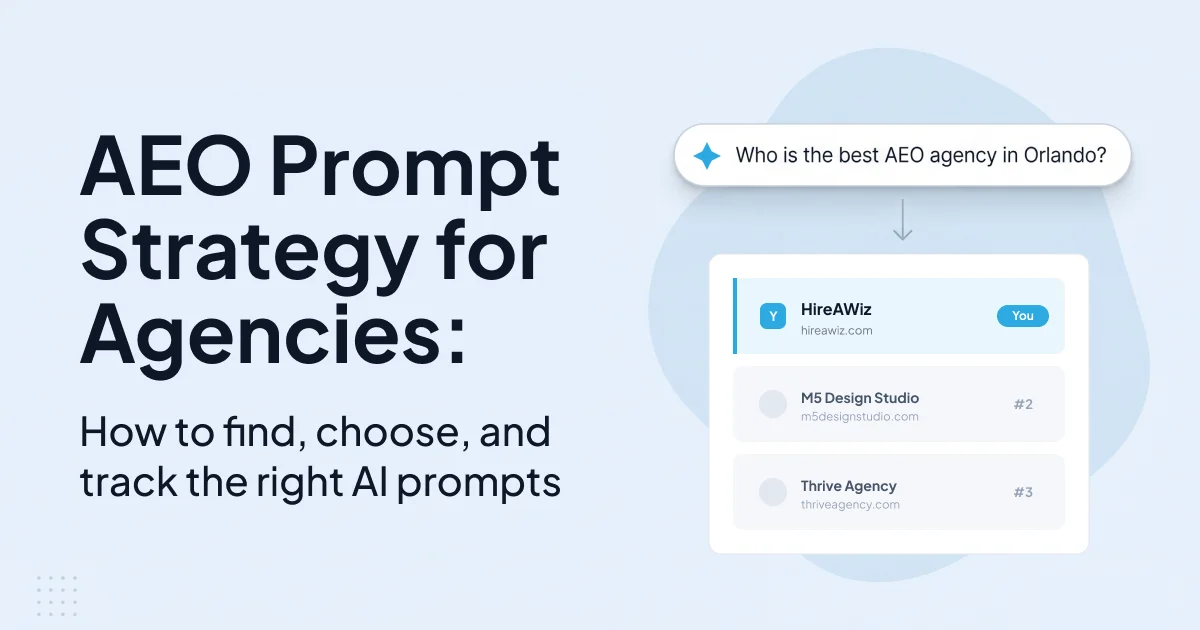
AEO Prompt Strategy for Agencies: How to Find, Choose, and Track the Right AI Prompts
Right now, your client's best prospects are asking AI to recommend a business like theirs. They are searching on AI platforms like ChatGPT, Gemini, Claude, and Perplexity. AI gives them a shortlist. If your client is not on that list, they usually do not get a second chance.
Most buyers do not go hunting past that shortlist. And the ones who do open Google often land in another AI answer. Google now leads with AI Mode and AI Overviews, not a clean page of links. Either way, the names the AI surfaced are the names that get the call. No appearance means no consideration. Closing that gap is what an AEO prompt strategy for agencies is built to do.
This is the cost of being invisible in AI search. And it is already being paid. Not next year. This quarter.
I see both sides of this every day. I run an agency, HireAWiz, and I founded My Web Audit. "Are we showing up in ChatGPT?" This question is quickly becoming the new "where do we rank on Google," and clients are starting to ask it. I've watched agencies scramble to answer this question, but most still do not have a clear response.
Here is the good news. The businesses winning AI search are not the biggest or the oldest. They are the ones who are showing up early, while the space was still in its infancy. There is still an early adoption advantage. A deliberate prompt strategy is how you get a competitive advantage before your client's competitors do. It starts with real prompt research, not guesswork.
Prompt research is the practice of finding and tracking the AI queries that decide whether your client gets recommended. It plays the same role for AI visibility that keyword research plays for SEO. The unit of measurement is different, the data is messier, and most agencies are doing it from the wrong starting point.
This guide fixes that, then shows you how to package the work as a service your clients will pay for.
The process is the same whether you are running it on your own agency or on a client. To keep things simple, this guide says "your client" throughout. Read that as "you or your client" depending on whose visibility you are working on.
TL;DR: An AEO prompt strategy is the practice of choosing, prioritizing, and tracking the questions buyers ask AI platforms about your business. You then improve your visibility for the ones that lead to a sale. Build it by mapping your client's topics and discovering real buyer prompts. Classify them by intent, then score each one for volume, intent, and winnability before you track anything. For agencies, the resulting audit becomes a paid foot-in-the-door offer that opens implementation work worth far more than the audit itself.
Table of Contents
- Why Your AEO Prompt Strategy Matters Now
- How Prompts Differ From Keywords
- The Prompt Research Process, Step by Step
- Scoring Prompts by Volume, Intent, and Winnability
- Query Fan-Out and Why It Is Your Back Door
- Tracking and the Attribution Problem
- Budgeting Your Prompt Set: The Economics of Tracking
- Packaging Your AEO Prompt Strategy as an Agency Service
- Frequently Asked Questions
- Mark Up Your FAQ for the AI to Read
- The Takeaway
Why Your AEO Prompt Strategy Matters Now
Buyers have started handing their decisions to AI. They describe a problem in detail, go back and forth, narrow the options, and arrive at a shortlist before they ever visit a website. By the time they land on your client's page, the decision is mostly made.
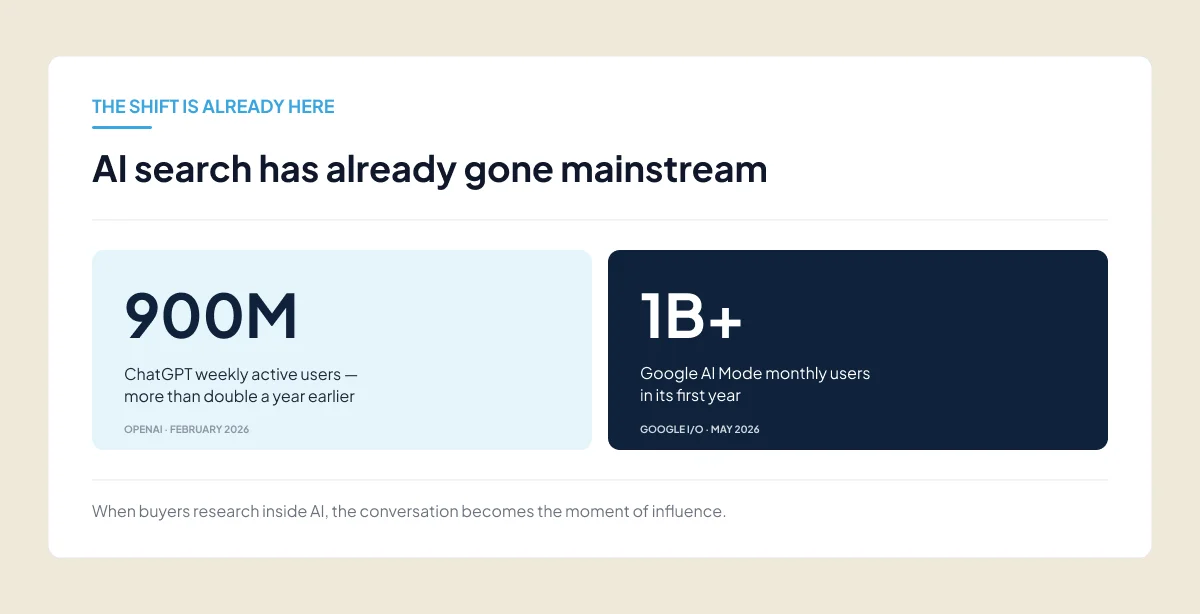
This is not a fringe behavior. ChatGPT crossed 900 million weekly active users in February 2026, an OpenAI figure that more than doubled the 400 million it reported a year earlier. It is not just ChatGPT, either. At Google I/O in May 2026, Google said its AI Mode had passed one billion monthly users in its first year, with AI Overviews reaching far more. When that many people research inside an AI, the conversation becomes the moment of influence.
Here is the part that should worry your clients. These AI platforms do not return ten blue links for the buyer to weigh. It returns a short, curated answer, often three or four names. That shortlist is the new first page, except there is no second page to scroll to. If your client is not named in the answer, they are not in the running, and the buyer rarely digs further to find them.
One thing to set straight: AI visibility sits on top of traditional SEO. Strong SEO usually produces strong AI visibility, because the content and third-party sources that earned your rankings are the same signals the AI reads, analyzes and cites. You are adding a conversational layer to a foundation that still does its job.
The opportunity for most businesses
Most businesses start from zero AI visibility. That sounds like bad news. It is actually the opening. The brands that build presence now, while the space is still not crowded, get to define how the AI describes their category. They do it before competitors wake up to the shift. Framing this as a land-grab tends to land better with clients than leading with fear.
How Prompts Differ From Keywords
A keyword is short and directional. "Digital Marketing agency." It tells you almost nothing about who is asking or what they need. A prompt carries context, constraints, and intent all at once.
The length difference is dramatic, and it depends on the interface. Google searches average about four words, AI Mode lands around seven, and ChatGPT prompts average roughly 23 words, because people treat the chat like a collaborator and load it with detail. Looking at whole conversations rather than single prompts, the average ChatGPT user types around 348 words per conversation, with opening messages near 103 words.
Consider a real buyer prompt: "recommend a digital marketing agency for a SaaS startup that needs SEO and paid search, works with early-stage companies, and is based in the US under a $5k monthly retainer." That single line hands the AI an action, a category, a buying context, and several constraints. The constraints are the important part. They are what push the AI out of explanation mode and into recommendation mode. A vague question gets a definition. A constrained question forces a comparison, and comparisons are where brands get named.
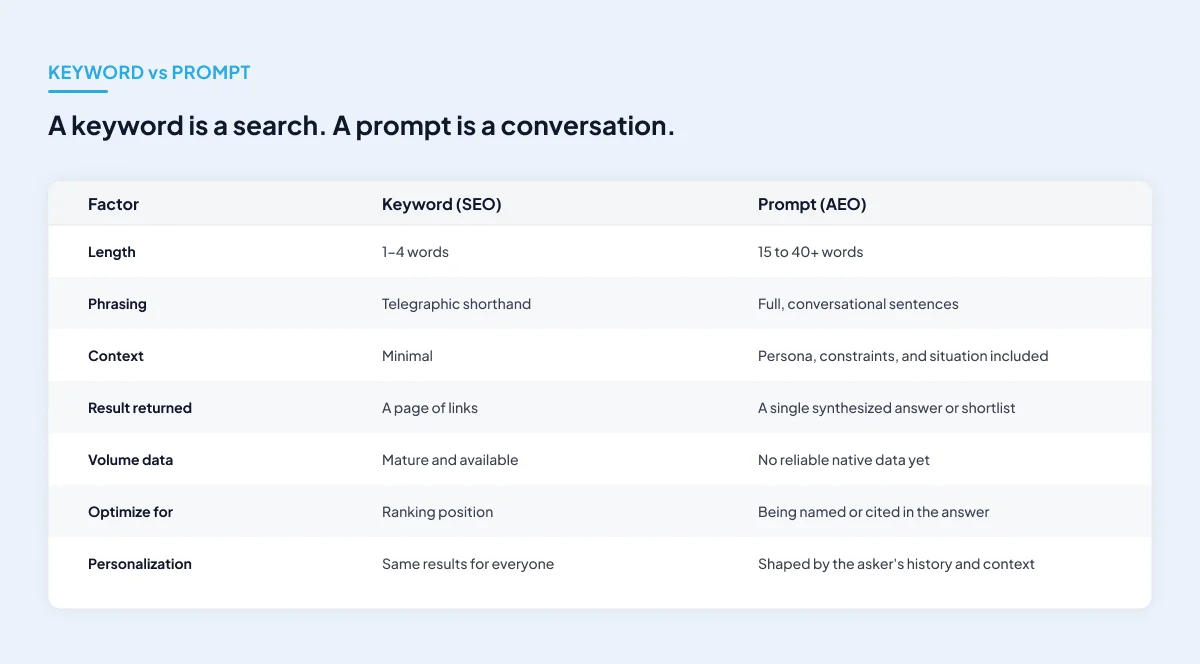
Here is how the two compare at a glance:
| Factor | Keyword (SEO) | Prompt (AEO) |
|---|---|---|
| Length | 1 to 4 words | 15 to 40-plus words |
| Phrasing | Telegraphic shorthand | Full, conversational sentences |
| Context | Minimal | Persona, constraints, and situation included |
| Result returned | A page of links | A single synthesized answer or shortlist |
| Volume data | Available and mature | No reliable native data yet |
| What you optimize for | Ranking position | Being named or cited in the answer |
| Personalization | Same results for everyone | Shaped by the asker's history and context |
Think like a buyer, not a marketer
Marketers think in solutions. Buyers think in problems. A marketer tracks "conversion rate optimization services." A buyer types "why are people leaving my checkout page without buying." Same topic, completely different language.
This matters because real prompts look nothing like the ones marketers guess. One analysis found real user prompts run 71% longer than synthetic ones (15.1 words versus 8.8), with 78.9% showing tool-finding intent and 52.1% using personal pronouns like "I" and "my". People describe their situation, not your product category. Your prompt research has to start from their words.
The Prompt Research Process, Step by Step
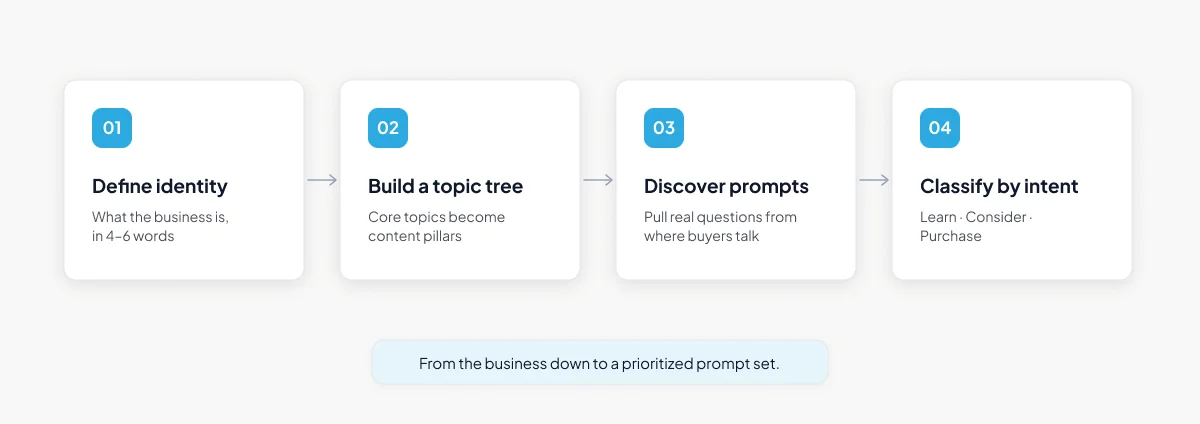
Here is the process I walk through. A solid AEO prompt strategy moves from your client's business down to a tracked, prioritized prompt set. Work through it in order.
Step one: define the business and its identity
Start with what the business is, in four to six words. This identity shapes how the AI describes the brand when someone asks about it. The AI does not invent your client from scratch. It assembles a picture from the sources it has read. A consistent, clear definition across the website and third-party mentions teaches it to describe the brand correctly.
Check sentiment too, not just whether the brand shows up. AI models pull opinions from popular review sites like Google, Yelp and those review sites that are industry specific like G2 for SaaS and Clutch for Web Agencies. If the AI says a client's service is slow or overpriced, there is usually a stack of reviews behind that judgment. Knowing the source tells you where to go to work.
Step two: build a topic tree
Break the business into its core topics. These become the content pillars and the spine of your prompt set. Here is the structure I use for my own agency, HireAWiz. The tracked prompts fall into four themes: AEO and AI visibility, SEO, web design, and a separate educational group for definitional questions. The first three are service pillars. The fourth catches early-stage buyers who are still learning the category. Each theme holds several prompts, and together they cover the full range of how a buyer might come looking.
This two-layer structure, topics on top and specific prompts underneath, mirrors how AI models organize information around topical authority and intent. Get the topics right and the prompts fall into place naturally.
Step three: discover prompts from real sources
Do not invent prompts at your desk. Pull them from where buyers already talk:
- Ask the models directly. Open ChatGPT or Gemini and ask what questions someone would have about the product or service. Ask it several ways. You are reverse-engineering the buyer's mindset.
- Mine Google's People Also Ask and People Also Searched For. These are real questions that map cleanly onto AI prompts.
- Read Reddit, Quora, and industry forums. The language buyers use in the wild, the exact phrasing of their problems, translates directly into prompts. If people say it in a forum, they are already thinking it. One of my own tracked prompts came straight out of this kind of language: "I'm a business owner spending money on SEO, but I can't tell if it's actually working. Who in Orlando can audit my current SEO and give me an honest assessment?" That is a buyer describing a problem, not searching a keyword.
- Use the client's own data. Export Google Search Console data and synthesize prompts from high-intent, high-impression queries. This grounds your prompts in proven demand.
Step four: classify by intent
Sort every prompt by where it sits in the buyer's journey. I use three buckets:
- Learn. Exploration and education. "What is answer engine optimization?"
- Consider. Comparison and evaluation. "Which AEO agency is better for B2B SaaS, [Agency A] or [Agency B]?"
- Purchase. High-intent, ready to act. "Best AEO agency for a B2B software company with a $5k monthly budget."
Those three buckets describe intent, meaning how close the buyer is to a decision. Framing it differently, prompts also fall into recognizable types by their shape: category prompts ("best SEO agencies for ecommerce brands"), comparison prompts ("MyWebAudit versus SemRush for agencies"), recommendation prompts, and problem prompts ("how do I get my business to show up in ChatGPT"). The two axes work together. A comparison prompt usually sits in the consider or purchase bucket, while a problem prompt often sits in learn. Comparison and purchase prompts are where visibility converts. Learn prompts build the funnel that feeds them.
In my own HireAWiz set, the learn bucket has its own theme. Prompts like "What's the difference between AEO and SEO, and do I need both?" will not close a deal on their own. But the buyer asking that today is comparing agencies next month. I want my agency in the answer when they get there.
Keep in mind that most buyers are not ready to purchase the day they first find a product. The majority are still deciding. Every time one of them asks the AI a question and your client appears, the eventual decision tilts a little further your way.
Scoring Prompts by Volume, Intent, and Winnability
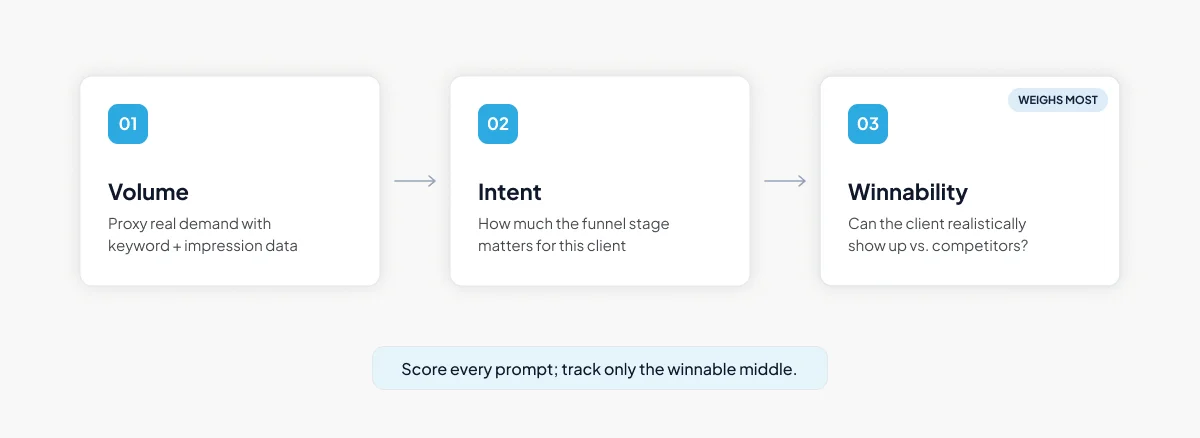
You cannot track every prompt, so you prioritize. This scoring step is where an AEO prompt strategy earns its keep. Score each prompt on three factors.
Volume
True prompt volume data does not exist yet. Some tools, including Semrush and Conductor, now sell what they call prompt volume, but read the fine print. The AI platforms do not publish how often a given prompt is typed. So these numbers are modeled estimates or pulled from small opt-in panels, not real query counts.
Treat them as a rough directional signal, not the kind of hard volume data you trust in keyword research. What works better is using your own keyword volume and impression data as a proxy for how much interest sits behind a topic. It is imperfect, but it is grounded in real searches, and it points you in the right direction.
Intent
Where does the prompt sit in the funnel, and how much does that stage matter for this client? A large, established brand might care most about head-to-head comparison prompts against its biggest competitors, in multiple markets and models. A new business might care more about problem prompts that build early awareness.
Winnability
This is the one agencies skip, and it is the most important. I learned it the slow way. I burned tracking budget on prompts my clients were never going to win, then had nothing useful to show at month's end. Winnability asks how realistically your client can show up for a prompt given the competition. Run through this checklist for any prompt that matters:
- Does the client's content answer this prompt specifically? If the site does not address it, the odds of appearing are low.
- Do trusted third-party sources support the client as an answer? AI leans heavily on earned media, so reviews, forums, and press carry real weight alongside the site itself.
- Are competitors already cited for this prompt? If so, what sources are putting them there?
- Can the client realistically close that gap?
Chasing prompts you have no chance of winning burns budget. Chasing prompts you already dominate teaches you nothing. Aim for the winnable middle, the prompts where a focused push produces a visible result your client can see.
Agency note: Winnability is also your strongest pitch tool. Walk a prospect through a prompt they are losing, and show them the competitor sources beating them. The conversation stops being a pitch and becomes a consultation.
Query Fan-Out and Why It Is Your Back Door
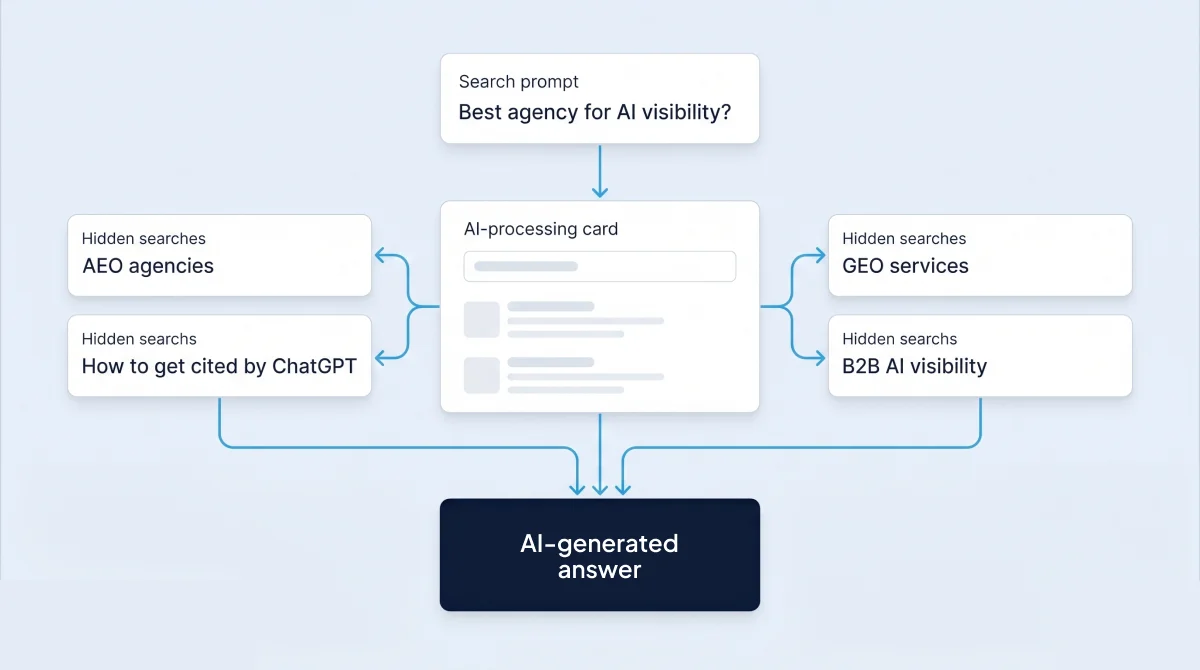
When an AI builds an answer, it rarely treats your prompt as a single query. It routinely breaks the question into smaller sub-queries, runs each one, and stitches the results into a single response. This is query fan-out, and it happens on ordinary questions, not just hard ones.
The behavior is measurable. When ChatGPT does reach for the web, it runs a search on about 31% of prompts and averages 2.17 searches each, with those queries running around 5.48 words. Google's AI systems go further, sometimes fanning a single request out across eight or more queries.
Here is why that matters for your client. Identify the sub-queries the AI runs to build an answer, and you can target those instead of fighting head-on for the main prompt. Take "best agency to improve my AI search visibility." The fan-out might include sub-queries like "agencies that do answer engine optimization," "how to get cited by ChatGPT," and "GEO services for B2B companies." Your tracking tool shows the real fan-out rather than leaving you to guess. Win those sub-queries, and you work your way into the answer for the prompt you actually wanted.
Tracking and the Attribution Problem
Once you have a scored, prioritized prompt set, you track it. Tracking by itself changes nothing. It is a measurement, not an action. What changes outcomes is the content and the third-party credibility you build off the back of what tracking reveals.
When you track, you can see mentions, citations, share of voice, sentiment, and which sources are feeding the answers. That last one is gold. If a competitor keeps appearing because three trade publications cite them, you now know your client needs comparable coverage.
Here is what an honest starting point looks like. In April I launched a new website after moving our agency from Phoenix to Orlando. I started tracking 30 prompts for HireAWiz across the four themes. My platform coverage was 0 initially since I got rid of most of my old blogs and all of my GEO signals were for Phoenix. As of mid may my score came back at 20%, with an average position of #4.2 and only one prompt earning full coverage across every model. Most prompts still show no position at all. That is not a failure; it is simply the baseline, the near-zero starting point where most businesses currently find themselves. This information precisely indicates which prompts I should prioritize, what content to create, and where to focus my efforts based on a competitive analysis of the citation data derived from the prompts I'm tracking.
Lock the set and keep it running
One discipline to set up front: lock your prompt set early. Most tools only start recording responses the moment you begin tracking a prompt, so they cannot show you history you never captured. Every time you swap prompts in and out, the old data stops and the new one starts. That breaks your month-over-month comparison and forces you to rebuild baselines by hand. Spend the effort to get the set right before you start, then leave it stable long enough to read a real trend.
Treat the work that follows as a standing program, not a launch. The brands cited for a prompt today may not be cited next month as competitors publish and models update. Stale content is the quietest and quickest way to lose ground. Run a refresh cycle of roughly 60 to 90 days on the pages tied to your highest-value prompts.
The attribution reality clients need to hear
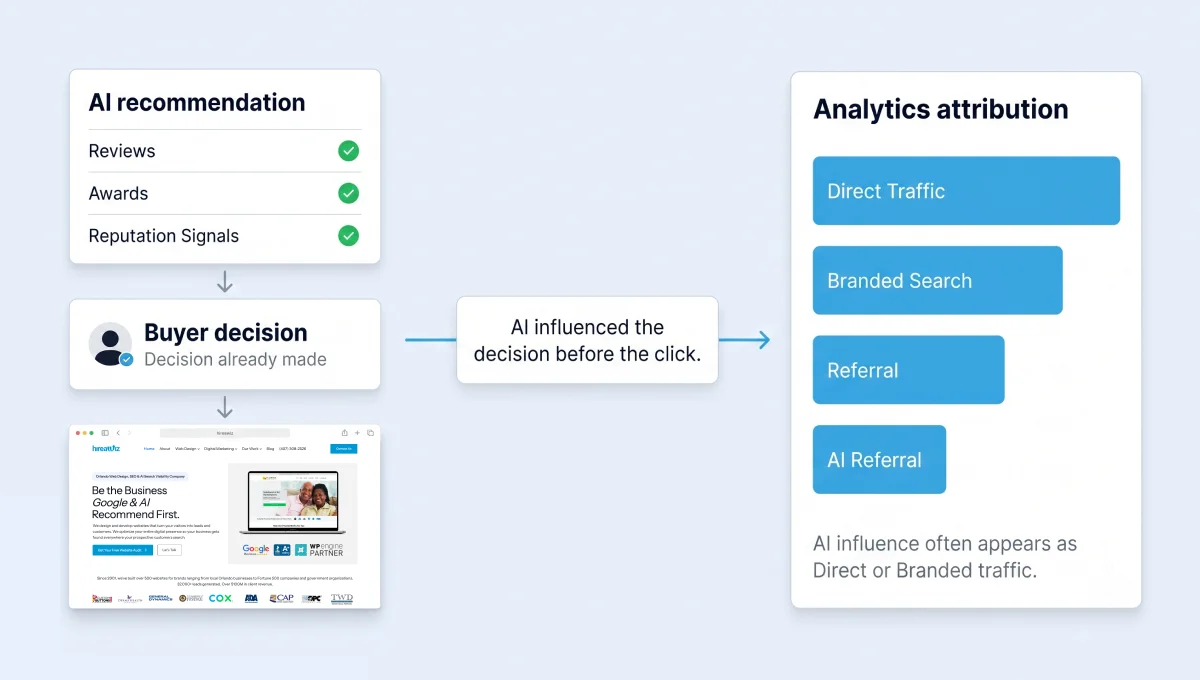
Be honest with clients about attribution. AI demand often resolves before it reaches the funnel. A buyer researches inside ChatGPT, decides, then visits the site directly or searches the brand name later. In Google Analytics, that has historically shown up as direct or branded traffic, not as an AI referral. The AI got the credit for the decision and none of the tracking.
It is worth making this concrete for clients. In a recent meeting, one of our clients told us they had just landed one of their largest remodel projects of the year. The homeowner had asked AI for the best remodel company in their city. Our client came up, complete with their reviews and awards, and won the job. Today that story is still the exception. It will soon be the norm.
Attribution is catching up
The good news is that tracking is improving fast. In May 2026, Google Analytics added a native AI Assistant channel. It automatically separates traffic from ChatGPT, Gemini, and Claude from the general referral bucket, with no manual setup. Privacy-first platforms like Matomo now offer dedicated AI referral and chatbot tracking, and tools from My Web Audit to Similarweb report on AI traffic too. For anything those miss, your server logs capture the AI crawlers and referral hits directly. You can still build a custom channel group in Analytics for platforms that are not yet recognized automatically.
None of this is perfect yet. A good share of AI-driven visits still arrive with no referrer, so they land in direct traffic and stay invisible. The honest framing for clients is this. With hundreds of millions of people using these tools to make decisions, presence is worth pursuing even where the tracking is incomplete. Some practitioners also report that branded search climbs as a brand shows up more often in AI answers. That link is still an observed pattern, not something cleanly proven.
How many prompts to start with
Start focused. Track around 30-50 prompts across the models that matter most to the client, usually ChatGPT, Google AI Overviews, and Gemini. You'll notice most tracking software don't offer Claude or only do in higher tiers because of the cost. My Web Audit includes it on all plans.
Watch performance against core competitors for a month. For a single product or service, internal testing at Semrush suggests roughly 10 well-chosen decision-stage prompts is enough to see whether AI consistently recommends a brand. Expand only where the evaluation criteria genuinely change, like a new persona, market, or use case. Minor wording variations produce the same result, so do not waste slots on them.
Budgeting Your Prompt Set: The Economics of Tracking
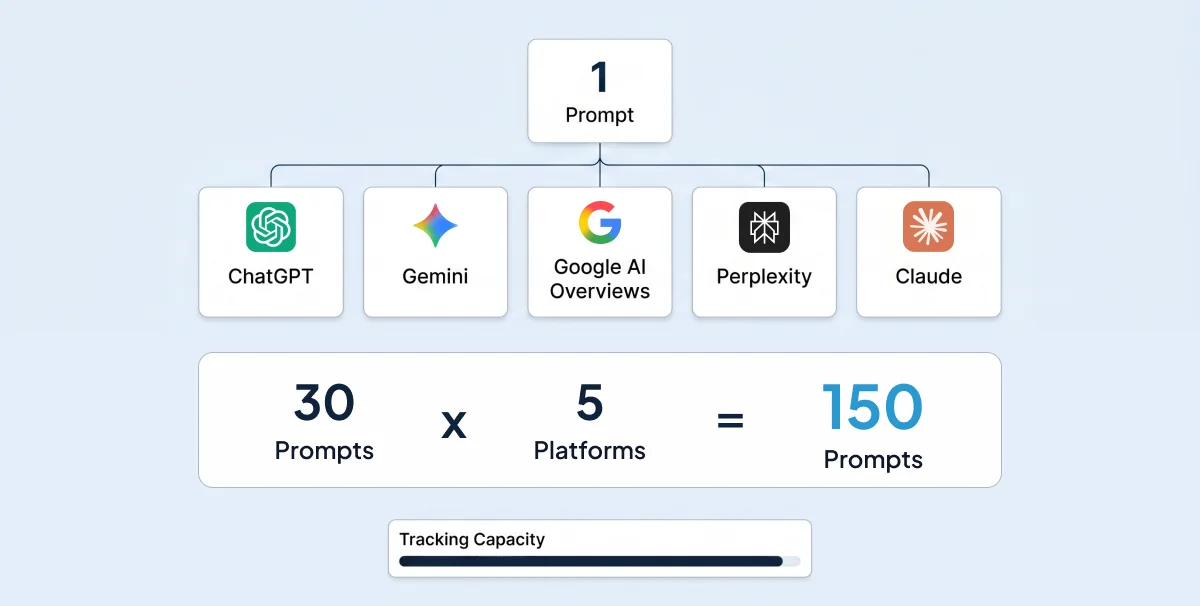
Most agencies treat the prompt count as a strategy question. It is also a budget question, and the budget runs out faster than people expect. Tracking tools cap how many prompts you can monitor, and you pay to add more. Plan around the cap before you build the set.
We recently launched AEO Visibility reports for our agency customers and they start at $9.99/mo.
One prompt can cost several slots
Here is the detail that catches people out. Many tools count a prompt once per platform, not once per prompt. Track a single question across ChatGPT, Perplexity, and Google AI Overviews and that one line of text costs three slots. Track it across seven platforms and it costs seven. A plan that looked generous at 150 prompts can shrink to 25 distinct questions in a hurry.
For an agency reselling this work, that math has to land in your pricing before you quote a client. Underestimate it and your tooling cost eats the margin on the retainer.
Match the prompt to the platform
Because every platform costs slots, do not send the same prompt to all of them out of habit. People use these engines differently. Someone might type "B2B sales enablement software" into Google. They would never phrase it that way to ChatGPT, where they describe their team, their stack, and their problem in full sentences. Write platform-appropriate prompts: short and keyword-shaped for Google AI Overviews, conversational and constraint-loaded for ChatGPT and Perplexity. Spraying one generic prompt across every platform wastes budget and muddies the data with results that do not reflect how anyone actually searches there.
That said tracking a single prompt across multiple platforms is probably the easiest and most commonly followed practice and is how most software platforms are setup to work.
Build the set in a spreadsheet first
Resist the urge to buy the tool and architect your prompts inside it. Building a strong prompt set takes time, input from stakeholders, and a few rounds of revision. Do that work in a spreadsheet before the subscription clock starts. You avoid paying for a tool you are not yet using. You also end up with a shareable document that anyone on the team or the client side can review first. This is also the cleaner artifact to attach to an audit deliverable.
Give each topic enough prompts to mean something
Thin tracking produces noise. If a topic has only two prompts, your daily mention rate can only ever read 0%, 50%, or 100%. That tells you nothing about a trend, especially given how inconsistent these platforms already are. You need a cluster per topic to get numbers you can actually read. A practical floor is around seven to ten prompts per topical report, enough to show a real pattern without draining the budget.
Lean on neutral prompts when money is tight
LLMs are happy to tell you whatever you set them up to say. Ask for ten reasons to buy a product or service and you get ten. Ask for ten reasons to avoid it and you get those too. Leading prompts burn slots on answers you engineered yourself.
Neutral prompts stretch a tight budget further. A question like "what are the top five [category] solutions for [the problem the client solves]" returns the real shortlist the AI considers. It shows you whether the client makes the cut and where they land. It gives up some specificity. But for a freelancer or a small client watching every dollar, it is the most information per slot you can buy.
Packaging Your AEO Prompt Strategy as an Agency Service
Everything above is the methodology. This section is for agency owners deciding how to turn an AEO prompt strategy into a service they sell and deliver. Clients can skip ahead to the conclusion.
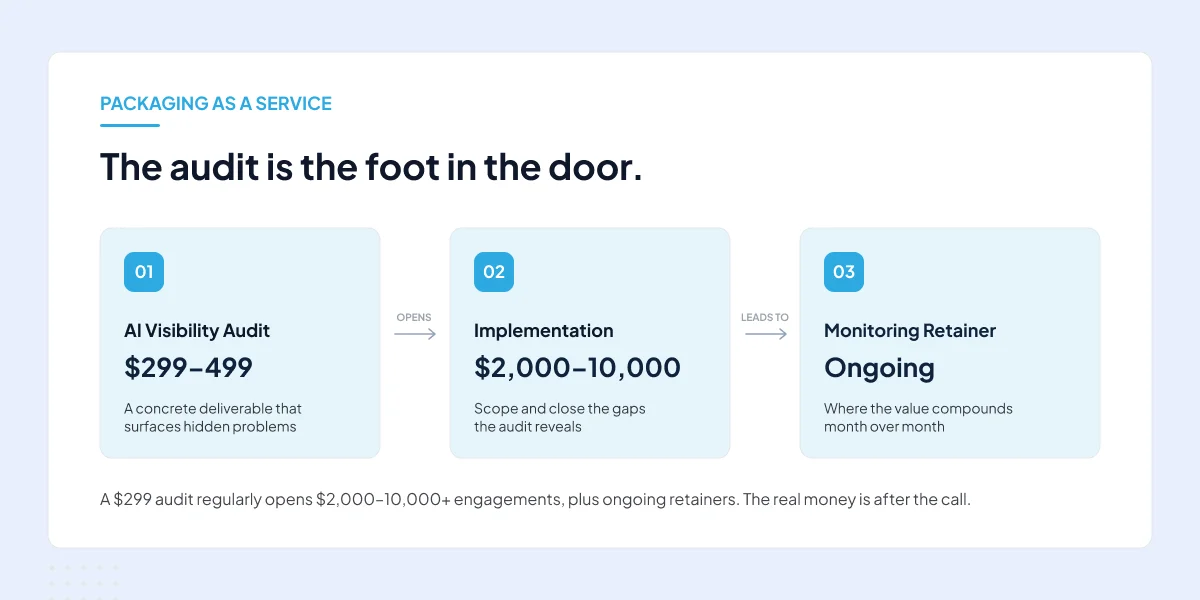
Prompt research is a natural foot-in-the-door offer. It is concrete, it produces a deliverable, and it surfaces problems the client did not know they had. That makes it an ideal lead into larger engagements.
Position it as a layer, not a replacement
Your clients have heard "SEO is dead" a hundred times and hopefully if you've done your job well, they do not believe it. If they do, you'll need to take the time to inform and educate them that AI visibility as a new layer on the work they already value. The Growth Stack framing works well here: a strong website foundation, traditional SEO, then AEO and GEO on top. You are extending their investment, not asking them to abandon it.
Lead with a paid audit, then scope the work
The cleanest entry point is an AI Visibility Audit. You build a prompt set for the prospect, track it, and present what you find: where they appear, where competitors beat them, and which sources are driving those results. That single audit is typically priced between $299 and $499+. It regularly opens the door to implementation work in the $2,000 to $10,000 range, plus ongoing monitoring retainers.
I've written a comprehensive blog on what an AEO audit for agencies to offer their prospects and clients should look like and how to present it. You can check out the AI Visibility Walkthrough Guide here.
A few delivery principles that hold up in practice:
- The audit represents expert manual work. Position it as four to six hours of skilled analysis, because that is the value the client is buying. Never frame it by how long the tool takes to run. In this case My Web Audit's AI visibility audit takes 10-15 minutes to run.
- Sell likelihood, not guarantees. AI platforms are non-deterministic. The audit captures the likelihood of citation, not a guaranteed placement. A batting-average analogy handles this objection well: you are improving the odds across many at-bats, not promising a hit every time.
- Identify competitors by citation, not geography. Your client's real AI competitors are whoever shows up in the citations, which is often not who they assume.
Turn the audit into a consultation
The reason this works as a sales motion is that you walk into the meeting already holding the prospect or client's real data. You are not pitching a hypothetical. You are showing them prompts their buyers are typing right now, prompts where a competitor gets named and they do not. The deliverable does the persuading. Your job is to scope the fix.
Sell the audit in one email
You do not need a funnel or a discovery call to sell an audit. You need one good email to clients who already trust you. I sent five of these one morning, spent under ten minutes because the template was ready, and closed two paid audits within thirty minutes. Neither buyer was even an SEO client. Both were on website care plans and did no search work with us. The email made the problem real and the offer clear enough that they replied and paid on the spot.
Here is the template, close to word for word. Swap in your name, your pricing, and your service details.
Subject: Quick question about [Business Name] + AI search
Hi [Name],
Quick question: do you know how [Business Name] is showing up on AI platforms like ChatGPT, Google Gemini, Claude, and Perplexity? What pages on your site are actually getting AI traffic today?
Most business owners cannot answer that, and the shift is happening fast. According to Bain & Company, around 60% of searches now end without anyone clicking a website. People are asking AI instead.
Right now, high-intent customers are asking AI for recommendations in your market. The businesses that get cited capture that traffic. The ones that do not are invisible to a growing segment of buyers ready to act. AI either recommends you by name or it recommends your competition. There is no middle ground.
I built something to fix this: the AI Visibility Audit. It is a full analysis of where you stand in AI search and what to do about it. Here is what is included:
- Test your visibility across ChatGPT, Claude, Perplexity, and Gemini
- Show exactly where you rank against competitors and what the AI platforms are citing
- Deliver a prioritized action plan to close the gaps
- Walk through everything together on a strategy call
Investment: $499. I am offering preferred pricing at $299 for the first five clients who reply this week. In exchange, I get case studies and referrals from businesses I trust as this service grows.
Reply if you are interested and I will share the ten search phrases I plan to use. You adjust them if needed, I get to work, and you will have the report in two to three business days. Then we walk through everything on a short strategy call so you know exactly what to prioritize.
[Your Name]
A few reasons this works:
- It opens with a question they cannot answer. Most owners have no idea how they show up in AI. That gap between "I should know this" and "I have no idea" is what gets the email read past the first line.
- It does not require a call to say yes. The ask is just to reply. No calendar link, no booking page. That low barrier lets people act on impulse instead of parking it on a to-do list.
- Preferred pricing reads as a fair trade, not a discount. Case studies and referrals in exchange for a lower price feels like an exchange, and it creates urgency without pressure.
- The ten search phrases do the heavy lifting. This is where your prompt research becomes the sales hook. Offering to share the exact prompts you would track previews the work and makes the client part of the process. It turns the purchase into a collaboration. Everything in the front half of this guide feeds this one line.
Follow up without being pushy
Your clients may not reply immediately taking you up on your offer after the first email. A short, well-timed follow-up keeps the conversation open and often gets a reply simply because it reminded someone of something they meant to answer. Two follow-ups are plenty. Send a first nudge two to three days later, offering to share the ten search phrases before they commit to anything. Send a final close-the-loop note five to eight days later, framing it as worth knowing before their competitors figure it out. That cadence recovers a meaningful share of non-responders without wearing out your welcome.
The real money is after the call
The $598 from those two audits was nice. It covered the tool and then some. But that was never the point. The point is what happens on the walkthrough call. When an owner sees competitors cited across AI platforms while they are invisible, the next question is always the same: "What do we do about this?" That is an implementation conversation worth thousands, covering SEO work, content strategy, citation building, and ongoing monitoring. Two audits in thirty minutes meant two of those conversations on my calendar within two weeks. Every audit you sell opens that same door.
For solo freelancers
If you are a one-person shop, the same process applies at a smaller scale. Use your own website as the proof of concept. Run the audit on yourself first, fix what it surfaces, and you have a live case study to show prospects. A VIP pilot with one willing client gives you a second. Two real examples beat any amount of claimed expertise.
Frequently Asked Questions
What is an AEO prompt strategy?
An AEO prompt strategy is a plan for choosing, prioritizing, and tracking the questions buyers ask AI platforms about your category. You then improve your visibility for the ones that drive a sale. It is the answer-engine equivalent of keyword research. Instead of targeting short search terms, you target full conversational prompts. You classify them by buyer intent and score each one for how realistically you can win it. The goal is to be named or cited in the AI's answer, not to rank a page.
How is prompt research different from keyword research?
Keyword research targets short, telegraphic search terms with reliable volume data, and you optimize for ranking position. Prompt research targets long, conversational questions loaded with constraints, and you optimize for being named in the AI's answer. Keywords return a page of links; prompts return one synthesized response. There is no mature volume data for prompts yet, so you use keyword and impression data as a proxy. The two work together: keyword research reveals the language buyers use, which feeds the prompts you build.
How many prompts should an agency track per client?
Start with around 25-50 prompts across the platforms that matter most, usually ChatGPT, Google AI Overviews, and Gemini. For a single product or service, roughly 10 well-chosen decision-stage prompts is enough to see whether AI consistently recommends a brand. Keep at least seven to ten prompts per topic so your visibility numbers mean something rather than swinging between zero and one hundred percent. Expand only where the evaluation criteria genuinely change, such as a new persona, market, or use case, not for minor wording variations.
What is query fan-out and why does it matter?
Query fan-out is how an AI breaks a single prompt into several smaller sub-queries, answers each one, and stitches them into a final response. It happens on ordinary questions, not just hard ones. When ChatGPT reaches for the web, it averages just over two searches per prompt. Google's systems can fan out across eight or more. It matters because the sub-queries are where citations actually happen. Target the sub-queries behind a prompt you cannot win head-on, and you can work your way into the final answer through the back door.
Can you track AI visibility in Google Analytics?
Partly, and better than before. In May 2026, Google Analytics added a native AI Assistant channel that separates traffic from ChatGPT, Gemini, and Claude automatically. Tools like Matomo, SE Ranking, and Similarweb track AI traffic too, and your server logs catch what they miss. The gap is that many AI-driven visits arrive with no referrer, so they still land in direct traffic and stay invisible. Treat the data as a floor, not a full picture, and pair it with prompt tracking to see where you actually appear.
Should agencies charge for an AI visibility audit?
Yes. A paid audit works better than a free one for new prospects. It sets the value of the work and screens for serious buyers. A typical price sits between $299 and $499, and it represents several hours of expert analysis. More importantly, the audit is a foot-in-the-door offer. Once a client sees competitors cited across AI platforms while they are invisible, the natural next step is an implementation engagement worth thousands. Add an ongoing monitoring retainer on top. The audit opens that door.
Mark Up Your FAQ for the AI to Read
One practical tip if you publish an FAQ like this on a client site: wrap it in FAQPage JSON-LD schema. Structured data makes your questions and answers machine-readable, which improves your chances of being lifted into AI answers and rich results. It is one of the most common gaps I see in audits, and one of the fastest to fix. Pair clean schema with answers written in the 75 to 95 word range that AI engines tend to extract. That gives the platforms an easy, quotable source.
The Takeaway
Prompt research is keyword research for a world where buyers ask AI before they ask Google. Start with the client's identity and topic tree. Discover prompts from where buyers actually talk, classify them by intent, and score each one for winnability before you track a thing. Then build the content and credibility that move the prompts that matter.
The agencies winning here are not the ones tracking the most prompts. They are the ones with a real AEO prompt strategy, doing the work the tracking points to.
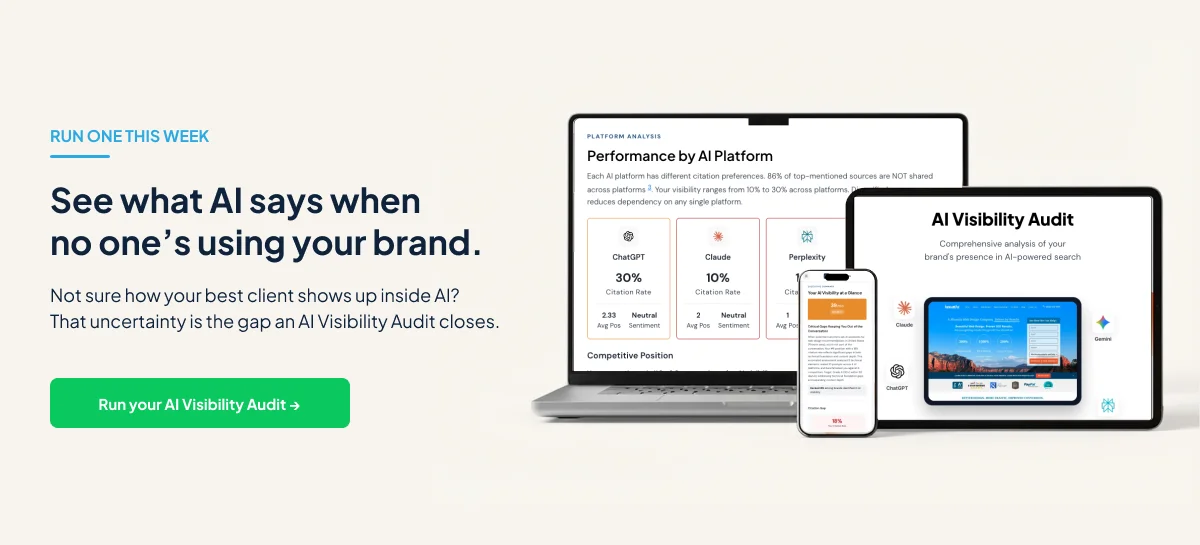
What does your best client look like inside the AI right now? If you are not sure, that uncertainty is exactly the gap an AI visibility audit is built to close. Run one this week, even on your own site, and see what the AI says when no one is using the brand name.

About Clifford Almeida
You may also like
Does Claude's Watermark Affect Your Google Rankings?
A client is going to email you about this. Some of you have already go...
Learn more
Agency Website Best Practices: 8 Pages That Sell And Market Your Agency 24/7
When was the last time you updated your About page? Your Process page?...
Learn more