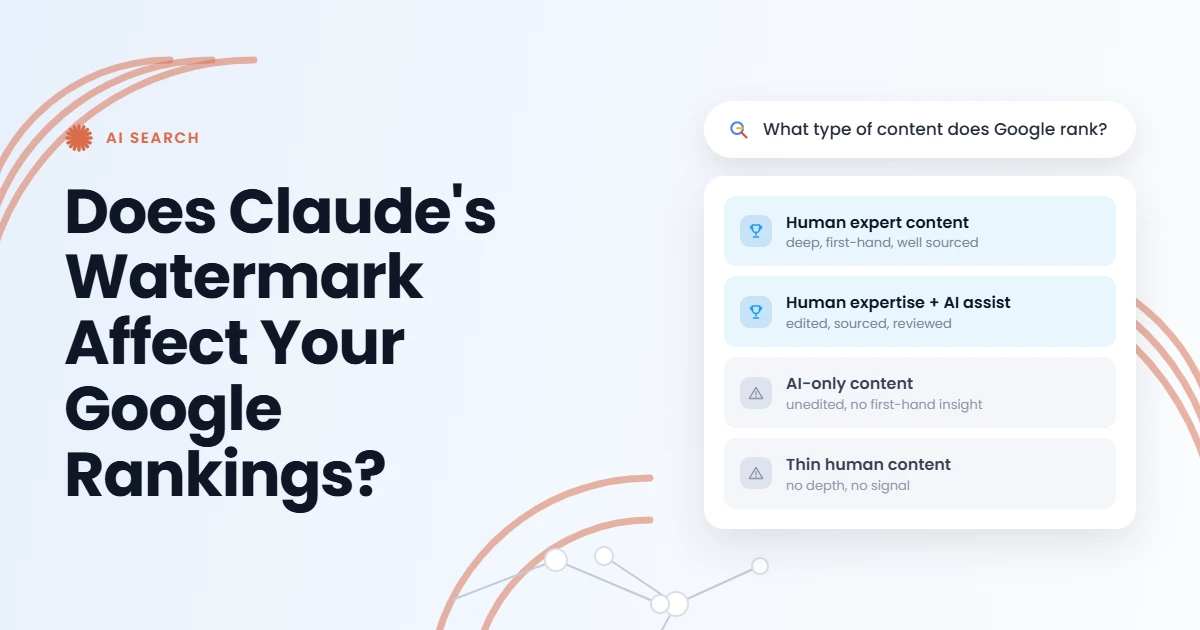
Does Claude's Watermark Affect Your Google Rankings?
A client is going to email you about this. Some of you have already gotten the message.
On August 10, Anthropic updated a support page confirming that Claude now embeds an invisible, machine-readable watermark into the text it generates. Within a day, somewhere between the press coverage and your client's inbox, "AI-generated text can now be marked" turned into "Google is going to penalize us and tank our client’s site."
So I went and read the source material. Anthropic's actual support page, plus the Google AI content guidelines going back to the original 2023 announcement. The short version: these are two unrelated systems solving two unrelated problems, and Google has never made how your content got written a ranking factor.
There is a real risk to agencies buried in this news. It has nothing to do with rankings.
Table of Contents
- What Anthropic actually shipped
- What does a Claude watermark actually prove?
- What do the Google AI content guidelines actually say?
- Does Google read AI watermarks?
- Where your actual risk sits
- The quality standard has not changed
- What this looks like on our own properties
- Where AI fits in an agency content workflow
- What nobody can tell you
- Frequently asked questions
What Anthropic actually shipped
Anthropic signed the EU AI Act's Article 50(2) Code of Practice on Transparency of AI-Generated Content. The watermarking rollout is how the company is putting that commitment into practice.
Two mechanisms are in play. Generated text carries an imperceptible watermark woven directly into the words. Because the mark lives in the text itself, Anthropic says it travels with the text when copied and pasted, and may survive some editing. Generated files in formats like .svg, .png, and .jpg get digitally signed provenance metadata following the C2PA open standard, which also flags whether a file has been tampered with.
Marking happens at the model level. It shows up regardless of which Claude surface produced the text: the API, the Claude app, Claude Code, Claude Cowork, or Claude Tag. It applies to Claude accessed through AWS, Google Cloud, and Microsoft Foundry.
Scope matters here, because coverage isn't universal yet. Models launched on or after August 2, 2026 support marking at launch, and Anthropic says it is still working to add support to models released before that date.
Two details most of the coverage skipped.
First, this is worldwide. The obligation itself is European, but Anthropic is applying marking everywhere Claude is offered, so US agencies are covered whether they have EU clients or not.
Second, Google signed the exact same Code of Practice on July 24, about three weeks ahead of Anthropic, and said it would use SynthID and C2PA to meet it. Roughly 190 organizations signed before the August 2 deadline. Hold onto the Google detail. It matters in a minute.
What does a Claude watermark actually prove?
Less than the headlines suggested, and this is where the reporting got sloppy enough that you can sound considerably smarter than whoever forwarded the article to your client.
Anthropic's own documentation is careful in a way the coverage was not. The support page states that when a supported mark is found, it indicates the content may have been processed by Claude. Not written by. Not generated by. May have been processed by.
That distinction carries real weight.
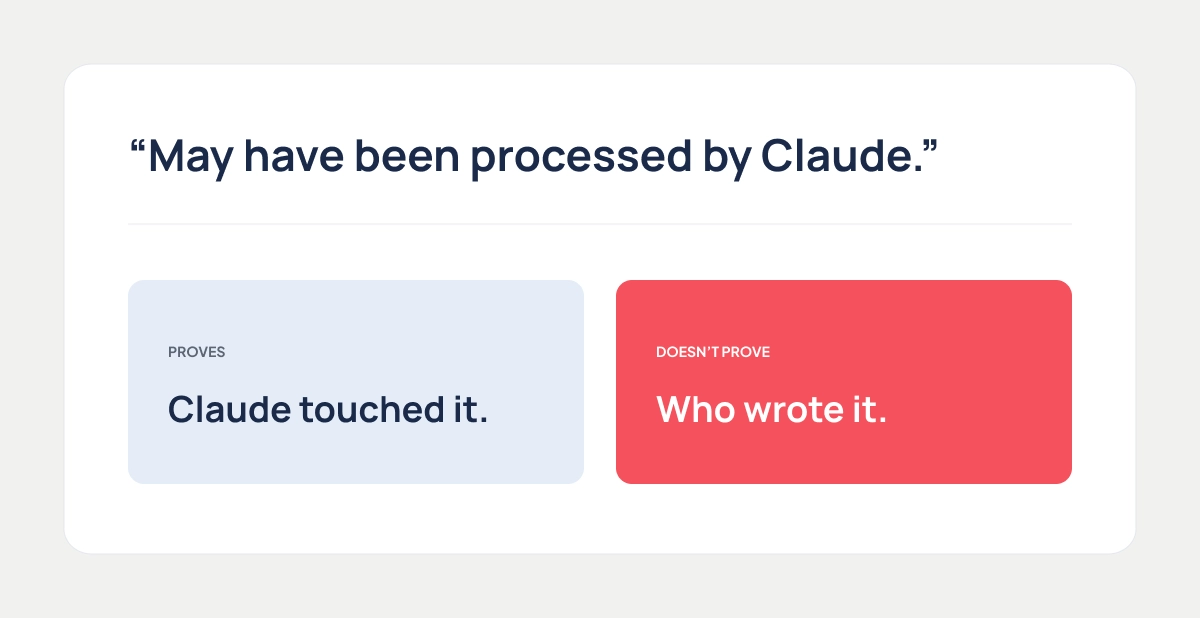
Why a positive hit says nothing about authorship
Anthropic names the limitation directly. The company lists proofreading, translating, summarizing, and converting files as cases where output carries a mark even though the underlying ideas, text, or data came from somewhere else.
Think about what that means in practice. A freelancer writes an original 1,500-word article entirely from her own head, based on her own client work, then runs it through Claude for a grammar cleanup, and the result carries a mark. So does the output of a translator working from someone else's human-written piece, and so does a finished draft that someone pasted in only to ask for a tighter headline.
The signal fails in the other direction too. Anthropic states plainly that a lack of a detected mark doesn't mean content wasn't AI-generated. Heavy editing or paraphrasing can strip it. Very short passages leave too little text for a reliable signal. Content from models released before marking was supported carries nothing at all. File metadata disappears through format conversion, re-saving, or a screenshot.
And the detection tooling has not shipped. Anthropic says it will support third-party detection and publish technical documentation, as the Code requires. That documentation does not exist yet.
So anyone treating a watermark hit as proof of authorship is making a claim the technology does not support. You can say that with confidence and cite Anthropic's own page when you do.
What do the Google AI content guidelines actually say?
Google permits AI-assisted content and judges it on quality, not production method. That position has been documented publicly since February 2023 and has not shifted since.
The Google AI content guidelines live across two primary documents plus the helpful content documentation. Most commentary quotes the first one and stops there.
The 2023 position that never moved
In February 2023, Google Search Central published guidance stating that appropriate use of AI or automation is not against its guidelines. Google's framing was that its focus sits on the quality of content, not on how content is produced.
The stated violation is narrow: using automation, including AI, to generate content with the primary purpose of manipulating search rankings. That's a spam policy issue.
Google also drew an analogy worth stealing for client calls. Roughly a decade earlier, there were similar worries about mass-produced human-written content. Google's published position is that nobody would have considered it reasonable to ban all human-generated content in response, so the sensible move was to improve the systems that reward quality. Same logic, applied to AI.
What scaled content abuse actually targets
In March 2024, Google renamed “spammy automatically generated content” to scaled content abuse. The definition:
Scaled content abuse is when many pages are generated for the primary purpose of manipulating search rankings and not helping users.
Google went further in the announcement, stating the policy applies “no matter whether content is produced through automation, human efforts, or some combination of human and automated processes.”
Read that twice. The policy is deliberately method-agnostic. Twelve human writers churning out thin, templated pages violate it. One well-researched AI-assisted article that answers a real question does not.
Now, in fairness, Google's spam policies page does name generative AI in its list of examples. The example reads: using generative AI tools or other similar tools to generate many pages without adding value for users. Anyone who sends you that line as a gotcha has stopped reading one clause too early. The qualifier is doing all the work. Many pages. Without adding value. Strip either condition and the example doesn't describe you.
Volume, intent, and low value. All three have to be present. Miss one and you're outside the policy.
Who, how, and why
Google's helpful content documentation, titled “Creating helpful, reliable, people-first content,” offers a self-assessment built on three questions: who created the content, how it was created, and why it exists.
The “how” section addresses AI head-on. Google asks whether the use of automation is self-evident to visitors through disclosures, whether you provide background on how automation was used, and whether you explain why automation was useful here.
Then it sets the bar: AI or automation disclosures are useful for content where someone might wonder how it was created, and Google suggests adding them when it would be reasonably expected.
A recommendation. Not a requirement, and never tied to ranking. One related note for clients: Google specifically advises against giving AI an author byline.
The “why” question is the one Google calls most important. Content should exist primarily to help people, and it should be useful to someone who lands on your site directly, with no search involved at all.
Does Google read AI watermarks?
Google has never said it does, and nothing in Google's published ranking documentation treats production method as an input.
Put the two systems side by side, and the confusion dissolves.
The one place Google surfaces provenance data is images. Through its C2PA membership, Google displays AI creation and editing information in the “About this image” panel in Search, Lens, and Circle to Search. That's a transparency feature for the person looking at the picture. Not a ranking signal, and not applied to text.
Here's the part that should settle the argument for any client still worried.
Google has been watermarking its own AI-generated text since 2024. Google DeepMind deployed SynthID-Text in the Gemini app and web experience, published the method in Nature, and open-sourced the code. Google then signed the same EU transparency code Anthropic did, on July 24 of this year.
So Google has spent two years doing to Gemini output roughly what Anthropic just did to Claude output. In those two years, Google has never used a text watermark as a ranking signal, never mentioned watermarks in its content guidance, and never suggested that marked text ranks differently from unmarked text. A company that has had this capability in-house since 2024 and declined to wire it into Search is not about to start because a competitor shipped the same thing.
Provenance is a disclosure problem. Ranking is a quality problem. The industry has spent a week collapsing the two.
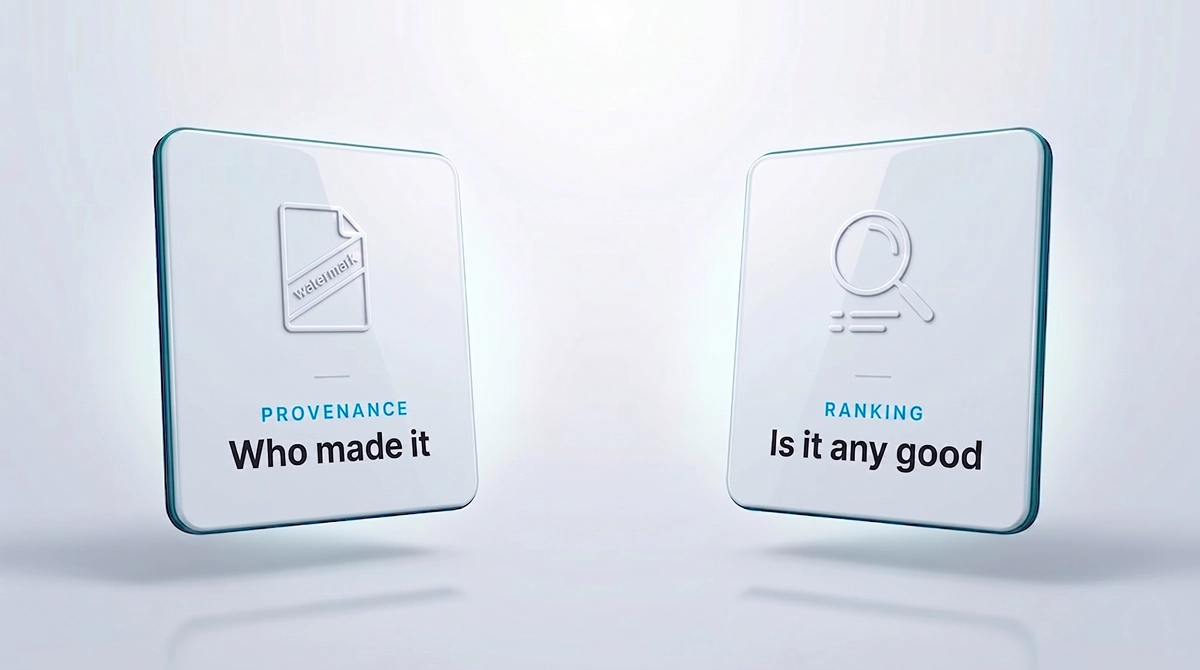
If a client pushes back, walk them through it on a call and pull the documentation up on screen. Show them the February 2023 language. Show them the scaled content abuse definition. Ten minutes of primary-source reading defuses a conversation that could otherwise cost you a retainer.
Where your actual risk sits
Now the part that should get your attention, because the exposure here is real. It lives in your client agreements.
Look at the contracts you've signed in the last two years. Plenty of agency Master Service Agreements (MSAs), content Statements of Work (SOWs), and Request for Proposals (RFP) responses contain some version of a warranty that deliverables are original and human-written. Some say it outright. Some bury it in a representations clause nobody read closely.
If you've been running AI-assisted drafts, or even cleanup passes, through Claude while warranting 100 percent human authorship, you have a contract problem waiting for the day somebody runs a detector.
A few things worth doing this month.
Stop signing blanket “no AI” warranties. They're close to unverifiable across freelancers and subcontractors, and they put you on the wrong side of a promise you can't actually police.
Replace them with an AI use clause that describes what you really do. Where AI assists in your process. That a human reviews and approves everything before delivery. That you verify factual claims independently. That you retain accountability for the work. Clients respond well to this because it describes a process they can evaluate.
Ask the same question of anyone you subcontract to. Your warranty covers their work.
Then put a plain-language answer in your sales collateral for when it comes up on a call. It will come up.

Worth knowing if you have European clients. Under Article 50(4) of the EU AI Act, deployers who publish AI-generated or manipulated text for the purpose of informing the public on matters of public interest carry their own disclosure duty. That's a client-side obligation, not a Google one, and raising it before they raise it with you is good positioning.
Two details from the European Commission's own guidance that will calm most of these conversations. Content generated and already published before August 2, 2026 does not need to be marked or labeled retroactively. And signing the Code of Practice is voluntary, so declining to sign is not itself non-compliance.
I'm not a lawyer, and this isn't legal advice. Penalties and scope vary, so have counsel look at anything specific. Just have the conversation while it's still hypothetical.
The quality standard has not changed
Strip away the watermarking news and what's left is the same bar that applied long before any of us had a language model.
Does the content inform someone? Do they finish it? Does it give them something they couldn't get from the eight other results on page one? Does it match what the person was actually trying to accomplish when they typed the search query?
That's the whole test. It's the test Google's documentation has described in one form or another for more than a decade.
E-E-A-T is the framework Google uses to describe it, and the first E, Experience, is where most AI-assisted content falls apart. A model can synthesize what's been published on a topic. It cannot tell your reader what happened on the sales call you ran last Tuesday, why the proposal died, or what you did the second time differently.
This is the practical takeaway from reading the Google AI content guidelines end to end. Every question Google asks a publisher to sit with, about who made this and how and why it exists, points back to whether a specific person with actual knowledge stood behind the work.
A model can help you say the thing. It can't be the one who knows it.
Does this sound familiar? It should. It's the same advice from 2015, 2019, and 2023. The tooling changed. The standard didn't.
What this looks like on our own website properties
Fair question at this point: does any of that actually hold up?
Here's what I can show you from our own two businesses. My Web Audit is our SaaS platform. HIREAWIZ is my digital marketing agency in Orlando. Both publish content produced the same way, with AI involved in outlining, research, drafting, and editing, and a human directing and approving every stage. Both pieces went live in Q2 of 2026. Both are surfacing at the top of both Google's AI-driven results and organic search right now.
Worth noting how short that window is. These pages have been live for a matter of months, not years, and they're already placing against domains with far more authority.
My Web Audit: query “ai visibility audit example”
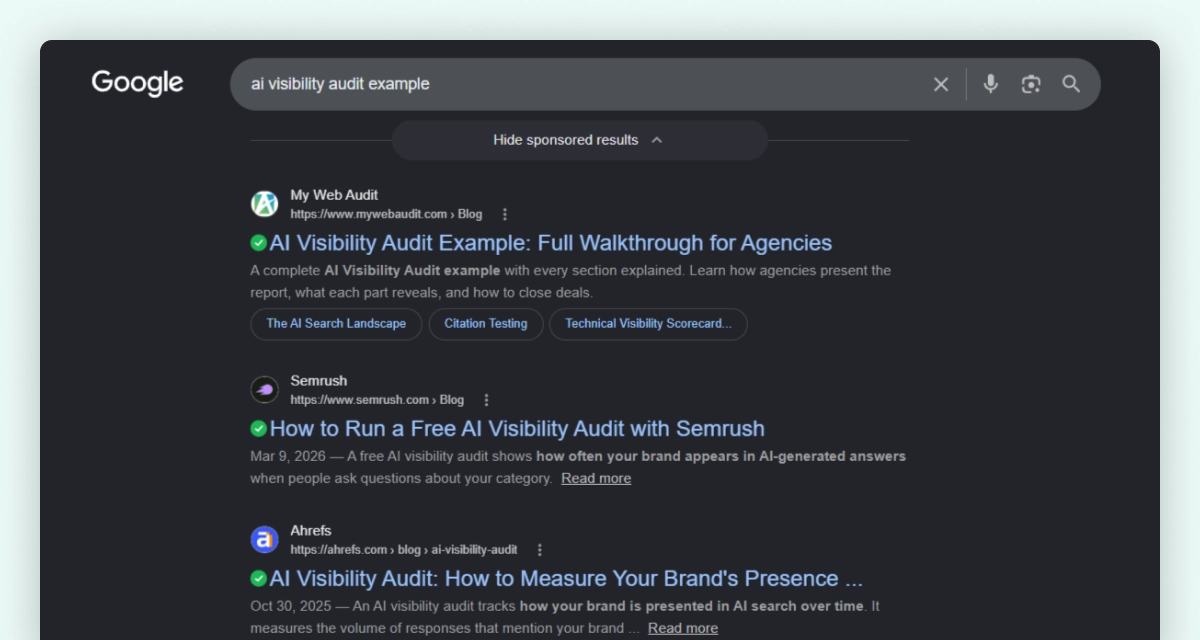
Position one organic. Above Semrush. Above Ahrefs. Those two are the reflexive authority answer in this category, and the page is outranking both on a commercial-intent query.
Notice the jump-to-section links Google generated under the result: The AI Search Landscape, Citation Testing, Technical Visibility Scorecard. Google doesn't publish exact criteria for those, but in practice they show up on pages with clean heading structure where each section covers distinct ground. That isn't a watermark question. That's structure.
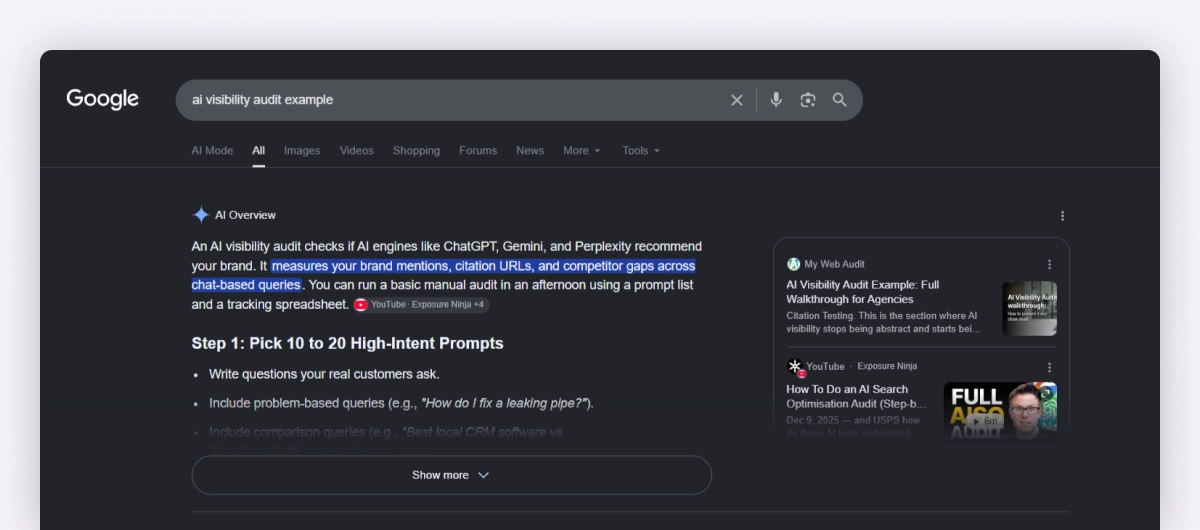
Same query, the AI Overview. My Web Audit sits at the top of the source panel, and the section Google surfaced is Citation Testing.
HIREAWIZ, query “best ai visibility agency orlando”
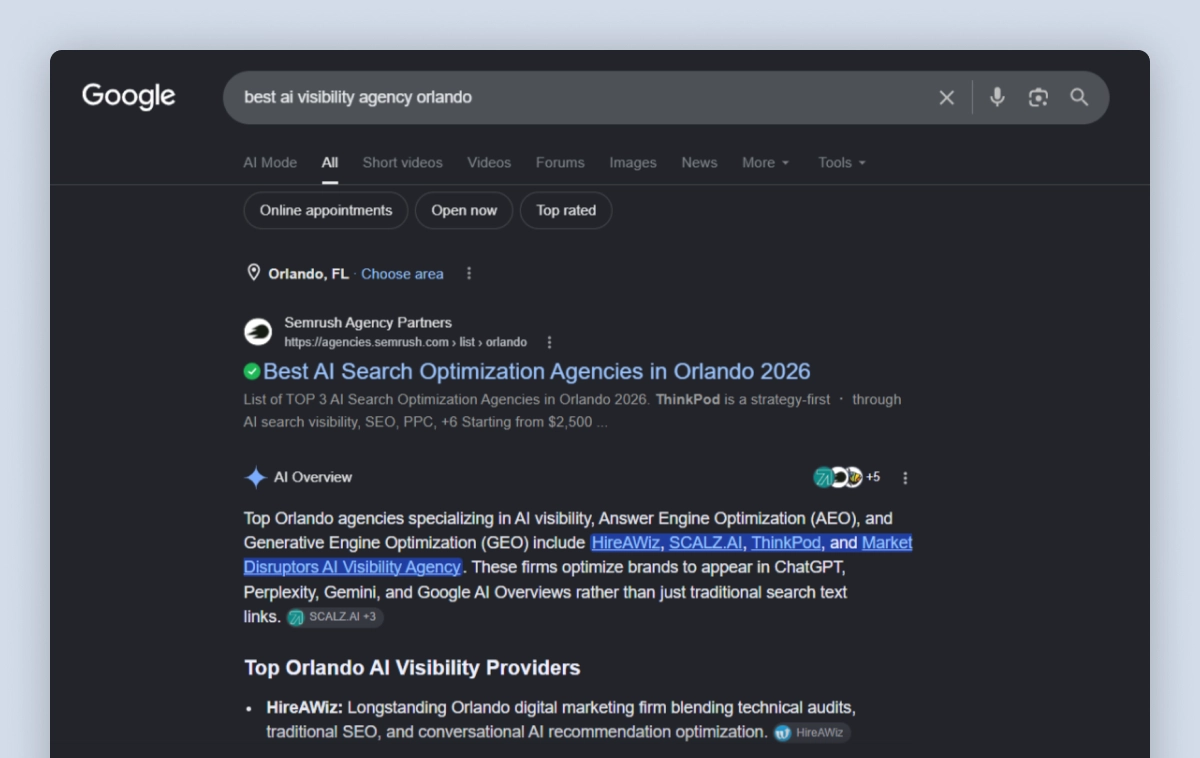
HIREAWIZ is cited in the body of the AI Overview and listed first in the “Top Orlando AI Visibility Providers” module underneath it, with a description Google assembled from our homepage and our AEO page.
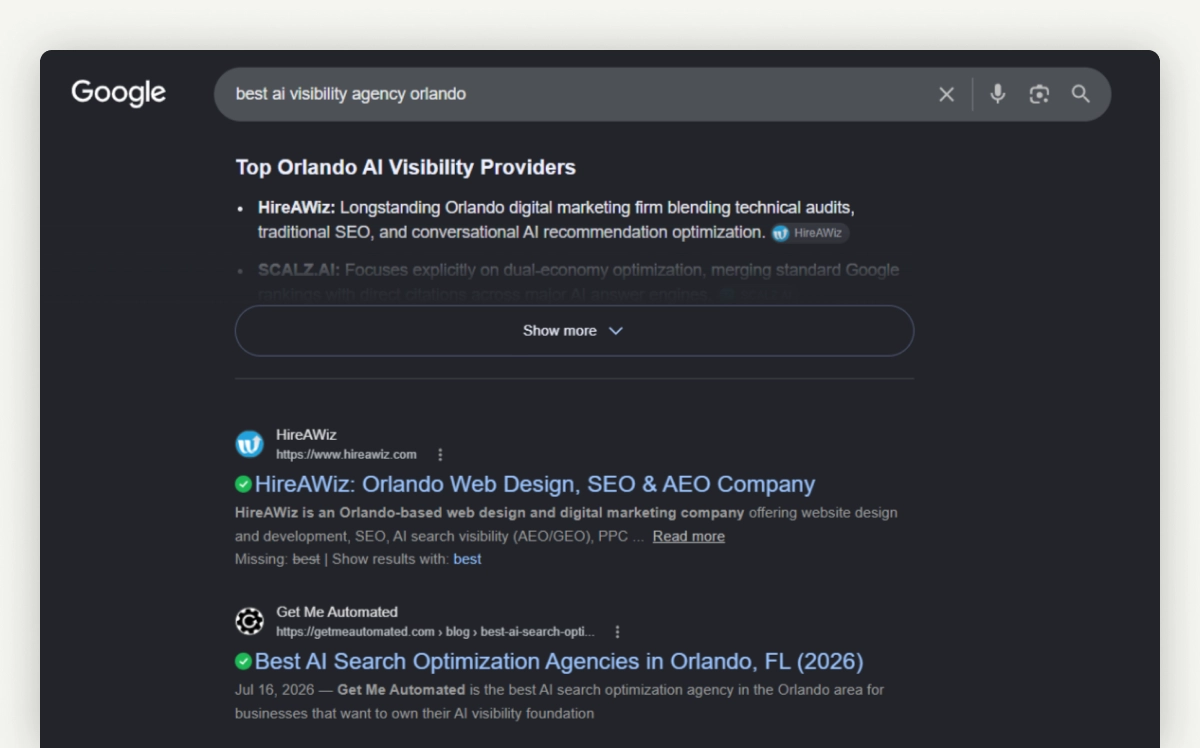
Both captures are from August 12, 2026. AI Overviews are non-deterministic, so if you run these queries yourself, you may see something different. That's the same likelihood-not-guarantee framing we use for the AI Visibility report, and it applies to our own results as much as anyone's.
The part that actually matters
Rankings are a vanity metric until something happens.
The captures above are from this month. The lead came in last month, off the same kind of placement, a few weeks after the pages had settled into position. An enterprise prospect I can't name under NDA found HIREAWIZ through those results. We sold them a $1,000 AI visibility audit, and we're now in procurement on a $6,000-plus monthly advisory and consulting retainer.
Sit with that for a second, because it's the whole argument for treating audits as a front door. A one-time four-figure diagnostic opened a recurring engagement worth more than $72,000 a year, where the client pays for judgment rather than hours.
Here's what I'd point to as the reason it worked, and none of it is about the tooling. The MWA walkthrough guide on AI visibility audits is built around real report sections with real interpretation, because we run these audits. The HIREAWIZ AI visibility service page describes how we actually deliver AEO work in this market. A model can help assemble either one faster. It cannot supply the underlying experience, and that experience is what both Google and the prospect responded to.
Which brings up the obvious thing. This article was written the same way. Outline, research, draft, edit, all AI-assisted. Every fact independently verified against primary sources, every claim checked, a human accountable for the result. If the argument here is sound, this post should hold up the same way those pages did.
Where AI fits in an agency content workflow
None of this argues for avoiding AI. Avoidance costs you margin, and your competitors aren't doing it. What matters is knowing which parts of the job a model can carry and which parts have to stay with you.
Four checks cover it. Each maps to something Google actually publishes in its helpful content documentation, which is why they hold up regardless of what ships next quarter.
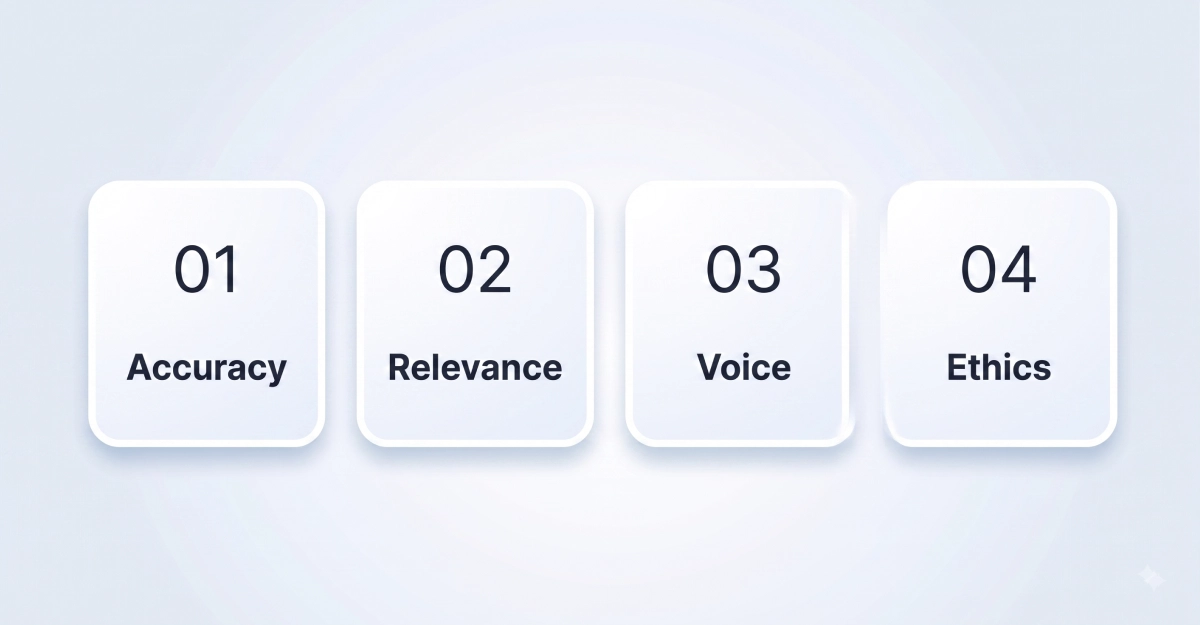
Accuracy
Google asks whether your content presents information in a way that makes a reader want to trust it, such as through clear sourcing.
Models produce confident, wrong numbers. They invent statistics, misattribute quotes, and describe platform behavior that stopped being true two years ago. Verify every figure, date, name, and claim against a primary source before it goes near a client. If a claim won't survive checking, cut it instead of hedging it.
This article is the example. Every factual claim in it links to a primary source: Anthropic, Google, DeepMind, or the European Commission. No SEO blogs, no aggregators. Several claims were cut during fact-checking because they traced only to secondary coverage and couldn't be confirmed at the source.
Relevance
Google's “why” question is the one it calls most important, and it comes down to whether the page exists to help someone or to catch a query.
Reader intent is the part a model guesses at. It has no idea that your client's compliance team vetoes the obvious recommendation, that their buyers are procurement officers rather than founders, or that the question behind the search term isn't the question they typed. You supply that. The draft gets shaped around it.
Where AI earns its keep here: research synthesis before you form a point of view, outlining, first drafts of sections where the facts are settled, editing passes, and repurposing finished work into other formats.
Voice
Google asks whether content provides original information, reporting, research, or analysis. That's the Experience leg of E-E-A-T doing its work.
This is the pillar a model cannot carry for you, for the reason covered earlier. What it can do is help you get a specific, hard-won thing onto the page cleanly, once you've supplied it. The engagement that went sideways. The tactic that quietly stopped working in March. The numbers only you know because you ran the campaign.
Then edit the tone until it sounds like your firm rather than like everyone's firm. That pass is where most AI-assisted drafts either earn their keep or give themselves away. By the way, you can work with AI to help shape your brand voice, so it doesn't sound generic.
There's a fair objection to all of this. Not every agency has a copywriter on staff, and plenty of owners are good at the work without being especially good at the writing. That's a real constraint rather than a failing, and there are two reasonable ways to work around it.
The first is to bring in a specialist for the pieces that are most important for your agency or your clients: pillar pages, service pages, sales pages, and the case studies you send to high-value prospects. We've worked with the same copywriter for about ten years, and he isn't the cheapest option, but he delivers great content without a lot of back-and-forth. He's also the person who helped us build the AI process described in this section, which is why the question was never whether to trust the writer or the tooling, but instead to focus on content quality and the value it delivers to readers.
The second is to handle it in-house and accept that your first advantage is your expertise and knowledge rather than polished copy. If you write plainly about the things you genuinely know, the quality tends to follow.
Either way, AI changed how quickly a draft appears. It didn't change who's accountable for whether that draft leads to great content that actually lands with the reader.
Ethics
Google asks whether your use of automation is self-evident to visitors through disclosures, and whether you provide background on how it was used. Its guidance is to add disclosure when a reader would reasonably expect it.
Two more that Google doesn't cover but your clients will. Don't pass off other people's work as original research. And don't paste confidential client material into an AI tool without checking what your agreement and their security policy allow. That one catches agencies off guard, and enterprise clients under NDA ask about it directly.
The pattern underneath all four is AI-assisted, human-directed, human-approved. A model accelerates the parts of content production that were always mechanical, and you spend the reclaimed hours on the parts that were always the value.
The same principle runs through how we think about audits. A tool handles data collection. The expert brings interpretation, prioritization, and the recommendation a client will actually act on. Nobody pays for the data. They pay for what you make of it.
What nobody can tell you
Time to be honest about the limits of everything above.
I can tell you what Google's documentation says today and what Anthropic shipped this month. I can't tell you what either looks like in the next year or two. Anyone who claims otherwise is selling a certainty that doesn't exist yet.
What we can see is direction. AI adoption isn't slowing in any industry, including ours. The way content gets found, processed, and repackaged is shifting underneath all of us: AI Overviews, AI Mode, ChatGPT, Claude, Gemini, and whatever arrives next quarter. Some of the surfaces we write for today didn't exist three years ago. A few of them won't matter three years from now.
That's the strongest argument I know for refusing to build a strategy around any single one of them.
Here's the thing about E-E-A-T. It has outlasted every core update, every format change, and now an entire provenance standard, because it was never a tactic to begin with. It's a description of whether a real person with real knowledge made something a reader is better off having read. Experience. Expertise. Authoritativeness. Trust. Those four hold up whether your reader arrives through a blue link, an AI Overview, a chatbot, or some surface that doesn't have a name yet.
So the practical answer to an unstable environment turns out to be an unglamorous one. Know your subject. Write for the person asking the question. Say something only you could say. Verify every claim you make. Put your name on it and mean it.
That's the instruction the Google AI content guidelines have circled for a decade, phrased a dozen different ways. Not because Google is generous, but because a search engine that surfaces useless pages stops being a search engine anybody uses.
And it pays, which is the part that matters to you or your client's business. It's not just about ranking and visibility; it's about getting the phone to ring, the form filled out, a prospect who arrives already convinced you know what you're talking about because they read something you wrote and it was better than what everyone else published. Content built that way tends to rank. It also tends to convert, because the qualities that make a reader trust you are the same ones that make a search engine trust you.
Chase the ranking alone, and you get thin content that might place for a while. Serve the reader properly, and you usually get both.
The watermark doesn't change that math. Nothing about this week's news does.
Wondering how your own site or a prospect's site measures up against the competition in Google or other AI platforms like ChatGPT, Perplexity, or Claude? Run an audit and find out. Start a free trial and generate your first report in minutes.
Frequently asked questions
Does Google penalize AI-generated content?
No. The published Google AI content guidelines state that appropriate use of AI or automation is not against its guidelines. Google penalizes scaled content abuse, which it defines as generating many pages primarily to manipulate rankings while providing little user value. That policy applies whether the content was produced by automation, by humans, or by a combination of both.
Can Google detect the Claude watermark in my content?
Google has never stated that it reads text watermarks, and production method does not appear as a ranking input anywhere in Google's published documentation. Anthropic's detection tooling has not shipped yet. Notably, Google has watermarked its own Gemini text output with SynthID since 2024 and has never tied watermarks to rankings in that time. Google does display C2PA provenance data for images in its “About this image” panel, but that is a user transparency feature rather than a ranking signal.
Do I have to disclose that I used AI to write content?
Google recommends AI or automation disclosures for content where a reader might reasonably wonder how it was created, and treats this as a quality consideration rather than a ranking requirement. Google separately advises against listing AI as the author byline. Contractual and regulatory obligations are a separate question, and under the EU AI Act certain published AI-generated text carries its own labeling duty.
Does a Claude watermark prove that AI wrote the content?
No. Anthropic's documentation states that a detected mark indicates content may have been processed by Claude, and lists proofreading, translating, summarizing, and file conversion as cases where a mark appears even though the ideas and text originated elsewhere. A mark shows Claude was involved at some stage. It says nothing about who wrote the underlying work.
Should my agency stop using AI for client content?
Google's guidelines do not require it, and avoiding AI entirely puts you at a cost disadvantage. The practical approach is AI-assisted drafting with human direction, independent fact verification, and human approval before anything is delivered, paired with a client agreement that accurately describes that process.

About Clifford Almeida
You may also like

Agency Website Best Practices: 8 Pages That Sell And Market Your Agency 24/7
When was the last time you updated your About page? Your Process page?...
Learn more
AEO Prompt Strategy for Agencies: How to Find, Choose, and Track the Right AI Prompts
Right now, your client's best prospects are asking AI to recommend a b...
Learn more